When you click on links to various merchants on this site and make a purchase, this can result in this site earning a commission. Affiliate programs and affiliations include, but are not limited to, the eBay Partner Network.
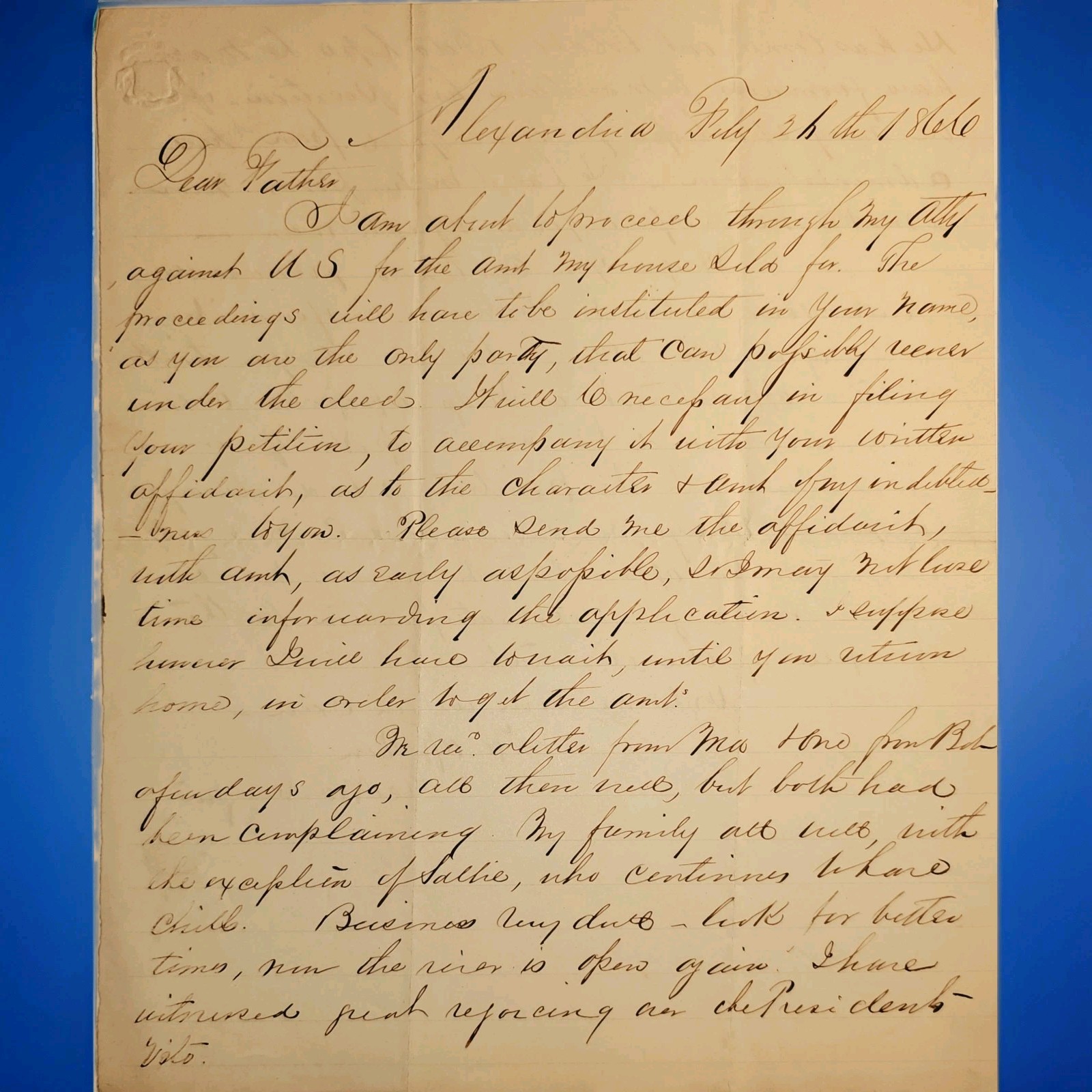
Original handwritten Reconstruction-era letter dated Alexandria, Virginia, February 26, 1866, signed “Geo. Washington,” identified with strong evidence as George A. Washington (1825–1896), a member of the extended Washington family and great-grandnephew of President George Washington.
This exceptional two-page letter was written only seven days after President Andrew Johnson vetoed the first Freedmen’s Bureau bill and contains George Washington’s contemporary reaction to that major Reconstruction political event, together with discussion of a federal claim arising from the wartime sale of his Alexandria property.
Washington writes to his father, Lawrence Washington (1791–1875), explaining that he is preparing, through his attorney, to proceed against the United States for the amount received when his house was sold during the Civil War.
He writes in part:
“I am about to proceed through my Atty against U.S. for the amt my house Sold for.”
Because the deed was apparently held in his father’s name, George explains that the proceeding must be instituted in Lawrence’s name and asks him to provide an affidavit describing the character and amount of George’s indebtedness to him.
The letter appears to document the early stages of the same federal property claim that was ultimately addressed by Congress several years later.
The Federal Property Claim
In 1873, Congress passed private relief legislation for George Washington and Sallie Washington of Alexandria, Virginia, concerning proceeds from the wartime federal direct-tax sale of a house and lot in Alexandria.
The legislation identified the property as No. 221 King Street, Alexandria, and authorized payment of the proceeds of the federal tax sale, less taxes and related charges.
The 1866 letter therefore appears to provide a remarkable contemporary window into the beginning of George Washington’s effort to recover funds from the United States following the Civil War.
The precise relationship between the property described in the 1873 legislation and the modern historic property at the same address should be treated cautiously unless the complete deed chain is established, but the documentary connection between George Washington, Alexandria, and the federal direct-tax claim is highly compelling.
Andrew Johnson and Reconstruction
The letter also contains a highly significant contemporary political passage.
George Washington writes:
“I have witnessed great rejoicing over the Presidents Veto.”
He continues that Johnson had:
“come out boldly”
and expresses hope that the President would maintain his position and thereby become:
“a good & great man.”
President Andrew Johnson had vetoed the Freedmen’s Bureau bill on February 19, 1866, exactly one week before this letter was written.
The passage provides an unusually immediate firsthand glimpse into conservative Virginia reaction to Johnson’s early Reconstruction policies.
Virginia Judicial Politics
Washington also asks his father about the appointment of John Critcher as judge, writing that he had expected Mayo to receive the position and believed Mayo’s appointment would have given greater satisfaction to the district.
John Critcher (1820–1901) was a prominent Westmoreland County attorney, former Virginia secession convention delegate, Confederate cavalry officer, judge, and later United States Congressman.
He served as lieutenant colonel of the 15th Virginia Cavalry during the Civil War and was appointed to the Virginia judiciary during the early Reconstruction period. He was later removed from office under congressional restrictions concerning former Confederates and subsequently represented Virginia in Congress from 1871 to 1873.
The “Mayo” mentioned is very likely Robert Mayo of Westmoreland County, a member of the prominent Virginia Mayo family and a figure associated with the same Northern Neck legal and political circles.
This discussion helps connect the Washington family to the political and judicial world of Virginia’s Northern Neck immediately after the Civil War.
George A. Washington
George A. Washington (1825–1896) was an Alexandria businessman and member of the extended Washington family.
He was the son of Lawrence Washington and Sarah Tayloe Washington and later operated the Alexandria commission merchant firm George Washington & Brother, dealing in grain, produce, and merchandise.
By the 1870s, Alexandria directories list George Washington as a commission merchant associated with Washington & Brother.
He married Sallie Foote Massie Washington (1832–1902), who appears jointly with him in the later congressional relief legislation concerning the Alexandria property.
Through his mother, George belonged to the extended family of the first President.
His maternal grandfather was William Augustine Washington, son of Augustine Washington Jr., the elder half-brother of President George Washington.
Accordingly, George A. Washington was a great-grandnephew of President George Washington.
This is an important distinction: the letter is obviously not associated with the first President himself, who died in 1799, but it was written by a documented member of the broader historic Washington family.
Lawrence Washington
The recipient and “Dear Father” was Lawrence Washington (1791–1875) of Westmoreland County, Virginia.
Lawrence Washington was an attorney, planter, and Virginia political figure associated with the Northern Neck.
He married Sarah Tayloe Washington (1800–1886) in 1819 and was the father of a large Washington family that included George A. Washington and Robert James Washington.
George’s question concerning Critcher’s judicial appointment makes particular sense when addressed to Lawrence, who was deeply connected to the legal and political affairs of the same Northern Neck region.
The letter also indicates that Lawrence was temporarily occupied with “duties in Richmond” in early 1866.
Sarah Tayloe Washington
George’s reference to “Ma” is almost certainly his mother, Sarah Tayloe Washington (1800–1886).
She was descended directly from the Washington family through President Washington’s elder half-brother Augustine Washington Jr., making her a great-niece of the President.
Her marriage to Lawrence Washington united two branches of the extended Virginia Washington family.
Robert James Washington
The “Bob” mentioned in the letter is very likely George’s younger brother Robert James Washington (1841–1910).
Robert later practiced law and was associated with his brother George in the Alexandria firm Washington & Brother.
Everyday Alexandria After the Civil War
Beyond its political and legal significance, the letter contains vivid details of daily life in Alexandria during the first year after the Civil War.
George reports that business is:
“very dull”
but expects conditions to improve:
“now the river is open again.”
The comment refers to the reopening of Potomac River navigation following winter ice, an important event for Alexandria’s commercial economy.
He also reports on his mother, Bob, his own household, and Sallie, giving the letter an unusually personal character alongside its major political and legal content.
Historical Importance
This letter brings together several important Reconstruction-era subjects in one contemporary document:
- Alexandria immediately after the Civil War
- A wartime property sale and federal compensation claim
- The federal Direct Tax system used in occupied Confederate territory
- President Andrew Johnson’s February 1866 Freedmen’s Bureau veto
- Contemporary Southern reaction to Johnson’s Reconstruction policies
- Reconstruction-era Virginia judicial appointments
- John Critcher and Northern Neck political affairs
- The extended family of President George Washington
- Alexandria commercial conditions following the reopening of the Potomac
Most significantly, the letter appears to document George A. Washington beginning his effort to recover proceeds from a wartime federal property sale years before Congress ultimately granted relief to George and Sallie Washington.
An outstanding original Reconstruction manuscript with strong Virginia, Civil War, Alexandria, Andrew Johnson, federal property-claim, and Washington-family associations.
Date: February 26, 1866
Place: Alexandria, Virginia
Signed: “Geo. Washington”
Format: Two-page handwritten letter
Condition: Original period manuscript with expected age toning, folds, handling, and other signs of use. Please review photographs carefully for exact condition.
Sold as an original historical manuscript and research item. Identification and historical context are based upon the contents of the letter and supporting genealogical, congressional, directory, and historical records.