When you click on links to various merchants on this site and make a purchase, this can result in this site earning a commission. Affiliate programs and affiliations include, but are not limited to, the eBay Partner Network.
A FIRST-GENERATION DR. WISTAR’S—CRUDE BEYOND BELIEF!
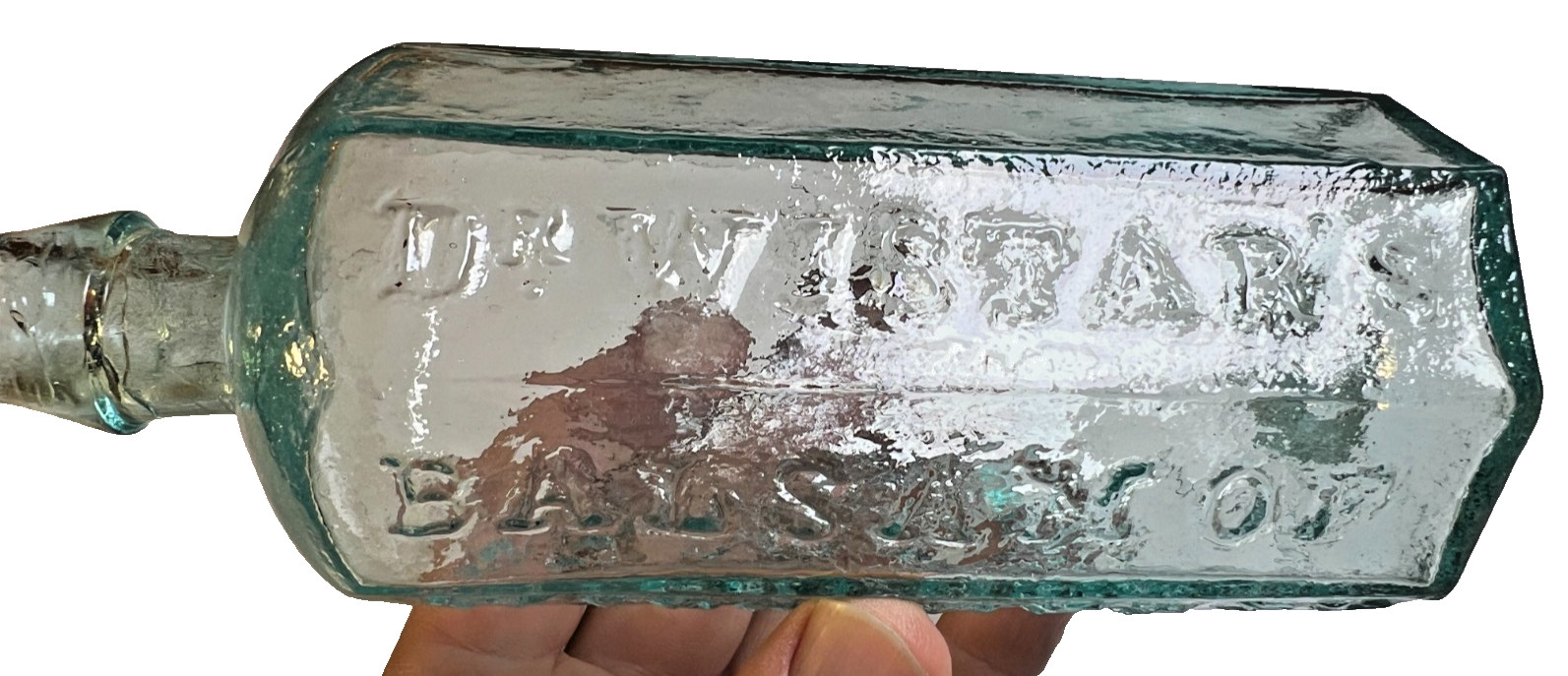
Here is an absolutely spectacular early Dr. Wistar’s Balsam of Wild Cherry patent-medicine bottle, produced for pioneering proprietor and promoter Isaac Butts of Philadelphia, Pennsylvania.
Standing 6⅜ inches tall, this beautiful blue-green aqua bottle is eight-sided and boldly embossed across five separate panels:
DR. WISTAR’S
BALSAM OF
WILD CHERRY
PHILADᵃ
I.B.
BEST DATE: LATE 1844–EARLY 1845
This is not an ordinary later Wistar bottle. The bottle’s large open pontil, dramatically irregular applied top, primitive glassmaking characteristics and “I.B.” embossing place it at the very beginning of the medicine’s commercial history.
An 1889 United States Supreme Court case preserved the remarkably detailed ownership history of the product:
In 1844, Philadelphia compounder Lewis Williams prepared the medicinal formula known as Wistar’s Balsam of Wild Cherry.
In May 1844, Williams transferred the formula and certain territorial sales rights to Isaac Butts.
Butts developed its distinctive packaging and launched an aggressive advertising campaign.
On March 1, 1845, Butts transferred his interest in the medicine to Seth W. Fowle, whose Boston company subsequently transformed Wistar’s into a nationally recognized patent-medicine brand.
The Abraham Lincoln Presidential Library identifies the molded “I.B.” as Isaac Butts and notes that his original licensed period lasted only approximately ten months.
No individual bottle can be assigned a provable day of manufacture, but the strongest evidence-based date for this extremely early example is:
Circa 1845—Most Likely Late 1844 or Early 1845
Its extraordinary crudity makes it entirely plausible that this bottle came from one of the earliest production runs made for Butts.
ISAAC BUTTS: THE MAN BEHIND “I.B.”
The final embossed panel carries the initials I.B., identifying Isaac Butts, the businessman who recognized the commercial potential of Wistar’s preparation.
Butts was far more than a distributor. He appears to have helped establish the medicine’s unmistakable identity through:
Its unusual eight-sided bottle
Bold five-panel embossing
Printed labels and wrappers
Newspaper testimonials
Warnings about counterfeit preparations
His initials and signature as supposed guarantees of authenticity
At a time when most medicines were sold in relatively anonymous containers, Butts made the package itself part of the sales campaign. Customers could recognize a genuine bottle of Wistar’s by its octagonal form before they could even read its label.
The precise glasshouse that physically manufactured these Philadelphia bottles has not been documented. The most accurate attribution is:
Produced for Isaac Butts of Philadelphia, Pennsylvania; Glasshouse Unknown
It was likely blown at a Philadelphia-area or neighboring Mid-Atlantic glassworks, but assigning it to a specific factory without documentary or mold evidence would be speculation.
AN EXTRAORDINARY PIECE OF EARLY AMERICAN GLASS
This bottle is absolutely alive with character.
The blue-green aqua glass is filled with:
Heavy overall whittle
Rich orange-peel mold texture
Hundreds of tiny seed bubbles
Long, twisted and elongated bubbles in the neck
Visible annealing lines
Ripples, waves and folds throughout the panels
Irregular glass distribution
Crudely formed shoulders
Strongly embossed lettering
A huge, bold open pontil scar
A dramatically uneven hand-applied top
The finish is especially remarkable. It is thick, heavily sloped and visibly manipulated by hand. Its unevenness is completely original to manufacture—not damage—and is one of the bottle’s most desirable features.
Every turn under the light reveals another bubble, ripple, swirl or fold left behind by the nineteenth-century glassblower. The glass seems to move beneath the surface.
This was not produced by an automatic bottle machine. A glassworker gathered molten glass on a blowpipe, expanded it inside a mold, removed the bottle, attached it to an iron pontil rod and then applied and shaped the mouth by hand.
The large scar on the base remains where that pontil rod was broken away.
No two examples emerged exactly alike—and this one must have been made on a particularly adventurous day at the glasshouse!
WHAT WAS WISTAR’S BALSAM OF WILD CHERRY?
Wistar’s was marketed as a powerful remedy for nearly every imaginable disease of the throat, lungs and chest, including:
Historical medical documentation describes Wistar’s Balsam as containing wild-cherry bark, alcohol and opiates.
Wild-cherry bark was traditionally valued for its cough-suppressing properties. Alcohol acted as a solvent and preservative, while the opiate component could quiet coughing, produce drowsiness and make a desperately ill patient feel temporarily better.
Unfortunately, the preparation could not cure tuberculosis, pneumonia or the other serious diseases named in its advertisements. It may have relieved the symptoms while the underlying illness continued.
In an age before meaningful drug regulation, however, dramatic testimonials and a handsome bottle could be nearly as commercially powerful as medical evidence.
HOW WISTAR’S WAS MARKETED
Wistar’s became an early masterpiece of American patent-medicine advertising.
Advertisements recounted dramatic stories of patients supposedly rescued after physicians had given up hope. The medicine was promoted as useful for routine coughs while also suggesting that it could reverse asthma, bleeding lungs and advanced consumption.
The campaign relied heavily upon:
Emotional testimonials
Newspaper advertisements
Printed handbills and broadsides
Branded wrappers
Recognizable packaging
Claims of widespread physician approval
Repeated warnings about dangerous warnings were especially clever. They frightened buyers away from competing preparations while reinforcing the idea that genuine Wistar’s was so successful that imitators were everywhere.
The unusual octagonal bottle, Philadelphia embossing and I.B. initials all helped turn the container into a form of permanent advertising.
LIFE WHEN THIS BOTTLE WAS MADEMedicine in 1845When this bottle was filled, modern germ theory had not yet been accepted. Physicians could recognize the wasting effects of tuberculosis but did not know that it was caused by bacteria.
Antibiotics did not exist. Reliable anesthesia was only beginning its public breakthrough, antiseptic surgery remained in the future, and many common treatments included alcohol, opium, mercury, bleeding, purging and botanical preparations.
Tuberculosis was among the most feared diseases of the nineteenth century. It often progressed slowly, producing coughing, weakness, fever, weight loss and bleeding from the lungs. Families desperate for hope were ideal customers for medicines promising relief—or even a cure.
There was no federal agency testing Wistar’s claims, requiring proof of effectiveness or demanding disclosure of every ingredient.
The Pure Food and Drug Act would not arrive until 1906, more than sixty years after this bottle was made.
Technology in 1845The telegraph was brand new. Samuel Morse had sent his celebrated Washington-to-Baltimore message only the previous year, in 1844.
Railroads and steamships were beginning to accelerate travel and commerce, but horses, wagons, canals and sailing vessels remained essential. Photography existed in the form of the daguerreotype, though having one’s portrait made was still novel and expensive.
Gaslight illuminated portions of major cities, while most American homes continued to rely upon candles and oil lamps. Indoor plumbing, electric lighting, telephones, automobiles and modern refrigeration were still decades away.
This bottle was manufactured entirely through human skill, heat, breath and hand-operated tools.
Politics in 1845James K. Polk became the eleventh president of the United States in March 1845.
The nation was consumed by:
The annexation of Texas
Westward expansion
The approaching Mexican-American War
Intensifying arguments over slavery
Immigration and religious conflict
The meaning and future limits of the United States
Philadelphia was one of America’s great manufacturing and commercial centers, but it was also a city experiencing profound social tension. The Philadelphia nativist riots had erupted in 1844, only months before this bottle was likely produced.
This little medicine bottle entered the world while the telegraph was shrinking distance, the United States was expanding westward and medical science remained balanced precariously between genuine discovery and theatrical clean, bright and mint.
No chips. No cracks. No haze.
The bottle displays strong embossing across all five lettered panels. The tremendous bubbles, whittle, orange-peel texture, annealing lines, pontil scar and dramatically uneven applied finish are all original manufacturing characteristics.
The sloping mouth is not damage. It is a fabulous example of how crudely the finish was applied and shaped by hand.
WHY THIS EXAMPLE IS SPECIALDr. Wistar’s bottles are encountered in several periods, sizes and degrees of quality. Many surviving examples are later, comparatively smooth, weakly embossed, stained, damaged or simply lacking visual excitement.
This bottle stands far above the ordinary examples because of its combination of:
Probable first-generation Isaac Butts production
Extremely early circa-1845 date
Large 6⅜-inch size
Strong blue-green aqua color
Bold open pontil
Wildly crude hand-applied top
Extreme whittle and orange-peel texture
Abundant seed bubbles
Long, twisted neck bubbles
Strong five-panel embossing
Outstanding mint condition
Having personally handled approximately a dozen examples, I can confidently say that this is the best of them.
It is an exceptional survivor from the birth of American patent-medicine branding: part medicine bottle, part advertising artifact and part hand-blown glass sculpture.
A truly superior example for the advanced collector of pontiled medicines, Philadelphia bottles, patent medicines, early American glass or nineteenth-century medical history.