When you click on links to various merchants on this site and make a purchase, this can result in this site earning a commission. Affiliate programs and affiliations include, but are not limited to, the eBay Partner Network.
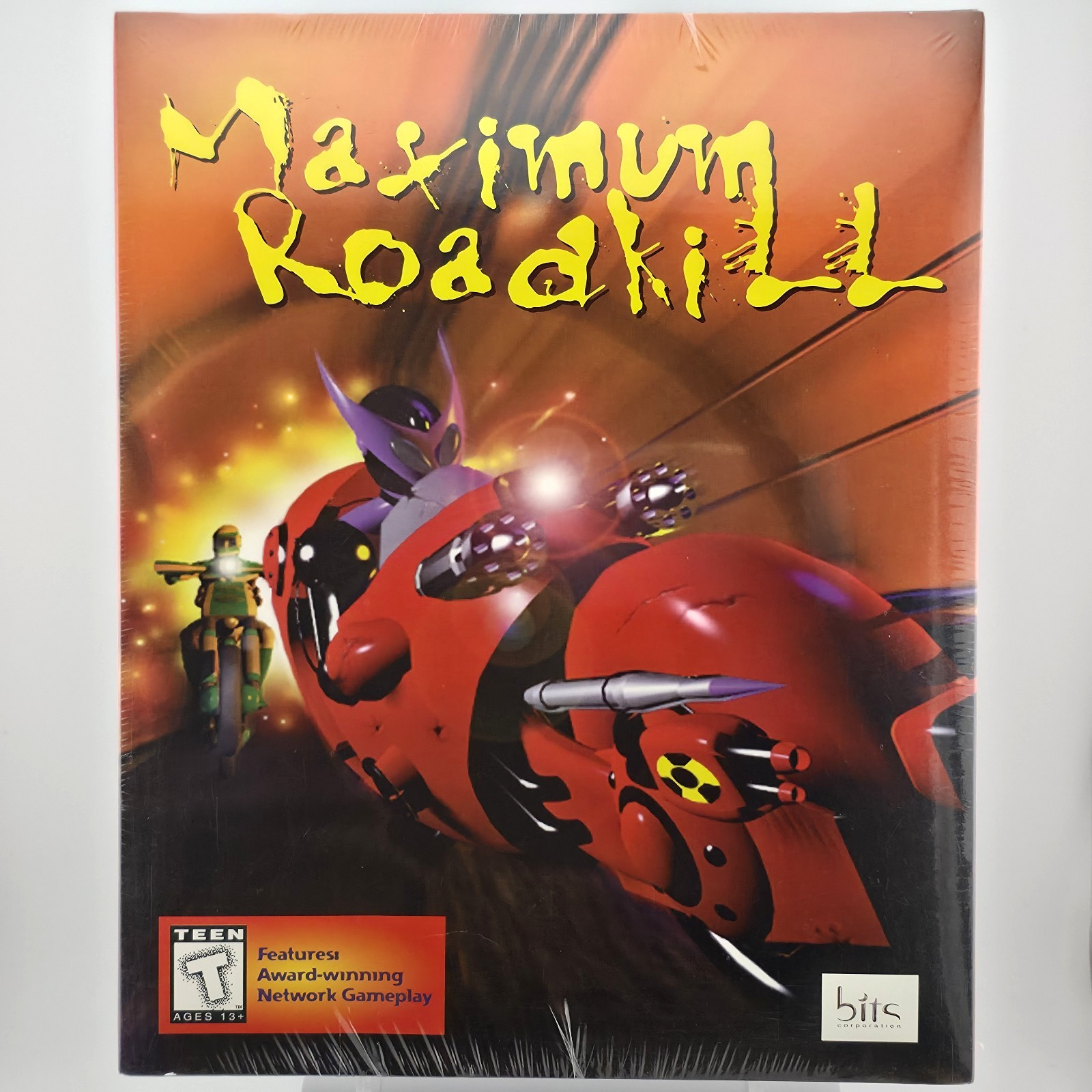
Experience Maximum Roadkill, developed by Bits Corporation and published by Take-Two Interactive on October 31, 1996. Maximum Roadkill is a futuristic arcade racer built around aggressive speed, tight track memorization, and a “survive the tournament” structure that pushes you through a set of escalating courses. The core loop has you picking a driver, learning the best racing lines, and threading high-speed turns while hazards and traffic-like obstacles punish sloppy corners. Each race rewards clean laps and confident drifting, with progression driven by consistently placing well across multiple tracks rather than mastering a single circuit. The pacing is immediate and run-based: load in, blast through a course, adapt to its unique layout, then jump straight into the next environment with new visual themes and new risk points. With its mid-’90s attitude and bright future-sport vibe, Maximum Roadkill plays like a pure arcade sprint designed for repeat attempts and faster times.
Two clear inspirations for Maximum Roadkill are Wipeout and OutRun, channeling the first’s futuristic racing identity and the second’s classic arcade emphasis on speed, flow, and instantly readable track challenges. You can see that influence in how Maximum Roadkill focuses on momentum—winning comes from committing to lines, anticipating turns early, and carrying speed rather than leaning on deep simulation tuning. In the genre’s evolution, Maximum Roadkill strongly aligns with later high-speed arcade racing like Need for Speed III: Hot Pursuit and Burnout, where velocity, reaction time, and course knowledge become the main skill expression. The design throughline is “arcade mastery”: inspirations establish speed-first racing and recognizable style, Maximum Roadkill applies that philosophy to a mid-’90s PC tournament format with rapid-fire tracks, and later titles refine the same foundation with more advanced physics and broader modes. If you collect racers that prioritize adrenaline and repetition-driven improvement, this fits cleanly into that lineage.
For collectors, Maximum Roadkill is a sharp 1996 big-box snapshot of PC arcade racing and pairs naturally with other fast, era-defining racers like Wipeout XL and Screamer, giving your shelf a cohesive “mid-’90s speed” row. It also displays well alongside Need for Speed II and Need for Speed III: Hot Pursuit, showing the progression from early high-speed PC racing into the more polished late-’90s wave. Maximum Roadkill complements combat-leaning adrenaline titles like Carmageddon as a cleaner “pure racing” counterpoint, letting you group different flavors of aggressive driving in the same section. If you’re building a Take-Two–era PC lane, placing Maximum Roadkill near Worms or Myth: The Fallen Lords creates a fun cross-genre snapshot of how varied that catalog could be. As a shelf piece, Maximum Roadkill fills the gap for collectors who want a distinct tournament-style arcade racer that’s unmistakably of its time.
Disclaimer: This game is sold as-is and is intended primarily for collectors; functionality cannot be guaranteed. PC games may have internal contents (jewel case/manual/inserts) that shift or rattle inside the box from the factory due to original packaging methods and age. By purchasing this item, you acknowledge and accept the condition as shown in the provided photos and understand that additional defects or imperfections may exist. All packages are insured, sealed in a cellophane bag, wrapped in bubble wrap, and shipped in a box for maximum protection. If you need any additional details, please message us before buying so there are no assumptions.
Seller Note: A retail sticker is present beneath the original shrink wrap. The shrink wrap shows typical micro-venting consistent with factory application; however, as with all vintage sealed PC software, exact sealing history cannot be guaranteed and is disclosed here for transparency.