When you click on links to various merchants on this site and make a purchase, this can result in this site earning a commission. Affiliate programs and affiliations include, but are not limited to, the eBay Partner Network.
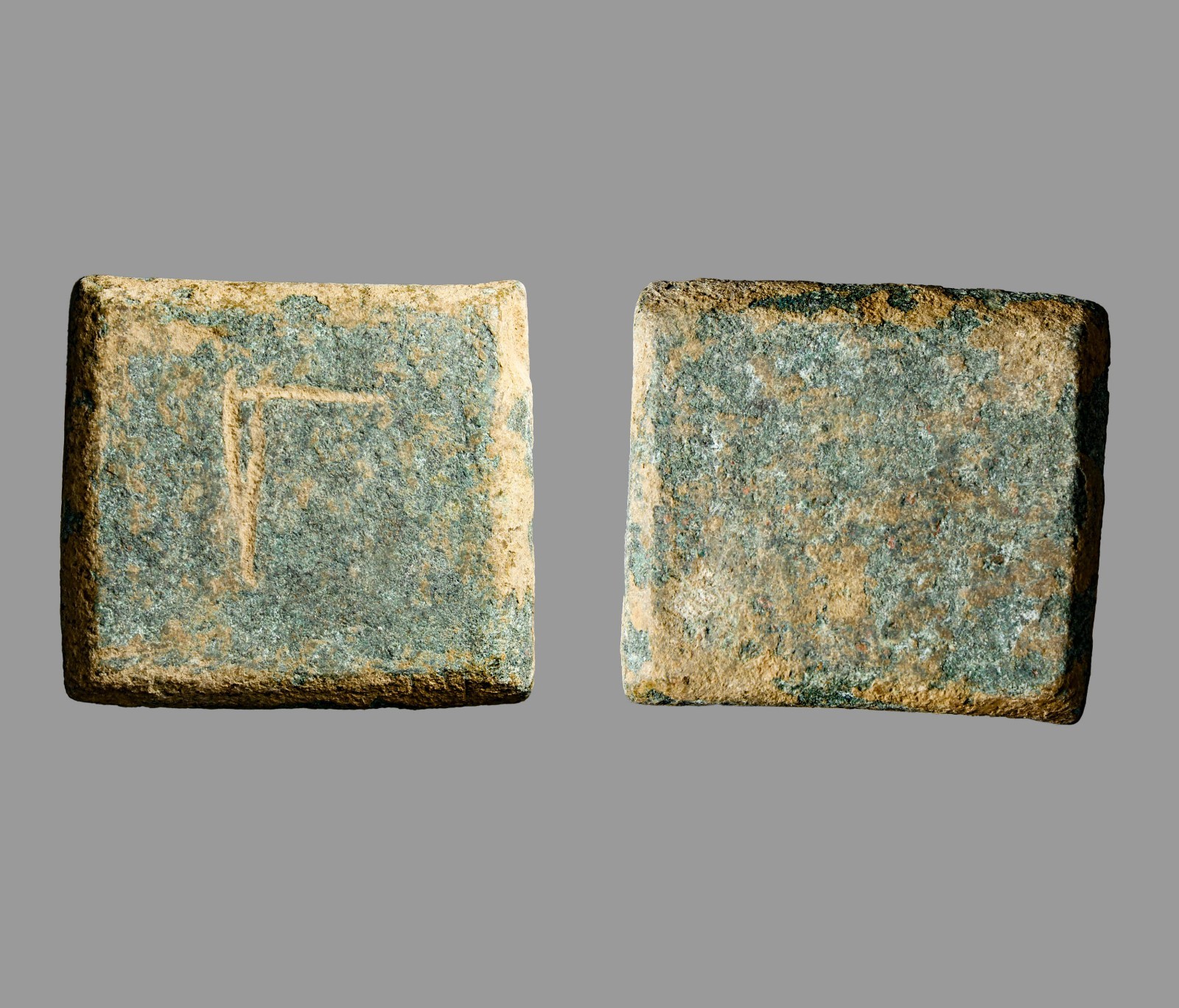
Ancient Romano-Byzantine Bronze 3-Ounce Commercial Weight Inscribed Gamma 79.27g 35mm Authentic
Authentic ancient artifact, guaranteed genuine and accompanied by a Certificate of Authenticity. Mediterranean / Holy Land find.
Culture: Late Roman / Early Byzantine Empire
Date: Circa 4th–6th Century AD
Material: Bronze (Copper Alloy)
Type: Square Commercial Weight / 3-Oungia (Three Ounces)
Size: 35 mm x 35 mm
Weight: 79.27 grams
Description
This is an exceptionally rare, heavy, and historically significant square bronze commercial weight from the transition period between the Late Roman and Early Byzantine Empires, recovered from the Eastern Mediterranean. Measuring 35mm across and weighing an impressive 79.27 grams, this block weight represents exactly Three Ounces (Oungia) within the standardized Roman-Byzantine economic system. The face of the weight features a deeply incised, bold Greek numeral Gamma (Γ), which mathematically denotes the value of "3" and serves as an official verification of its mass.
In the Byzantine marketplace, strict imperial laws regulated trade, and merchants were required to verify transactions using official weights checked against master standards kept in local basilicas or by the market overseer (Agoranomos). A weight of this substantial size was utilized by merchants, money changers, and tax collectors to weigh out high-value commodities, bulk spices, or quantities of precious gold and silver coinage. Its current weight of 79.27g sits perfectly within the expected historical tolerance of the theoretical 3-ounce standard (approximately 81.9 grams), accounting for natural microscopic surface loss from centuries of active commercial wear and eventual burial.
The artifact displays a spectacular, completely uncleaned archaeological presentation. The solid bronze module has developed a mottled, deep-green and earthy brown patina, beautifully highlighted by heavy, stable layers of cream-colored calcareous soil encrustation. This thick mineral matrix has anchored itself tightly to the bronze surfaces over fifteen centuries, creating a highly tactile and visually striking "as-found" aesthetic.
Authentication
The weight demonstrates impeccable diagnostic signatures of genuine ancient metallurgy and long-term environmental interment. The incised Greek letter Gamma displays characteristic hand-cut irregularities and historic wear within the grooves, which are partially filled with genuine, ancient soil compacted to stone-like hardness. Under magnification, the edges of the square form show uneven, manual smoothing typical of early Byzantine casting shops rather than modern precision milling. No modern casting seams, filing lines, or artificial chemical treatments are present.
Comparable Examples & References
Official Byzantine commercial and coin weights are highly prized by academic institutions and numismatists. Extensive typological collections of square and circular bronze weights inscribed with Greek value markings can be studied in the Dumbarton Oaks Collection in Washington, D.C., and the British Museum in London. For detailed academic reading on the metrology and imperial regulation of the Byzantine marketplace, collectors can refer to Simon Bendall's Byzantine Weights: An Introduction and Entwistle’s contributions in The Economic History of Byzantium.
Condition
Excellent archaeological condition, presenting an entirely stable and authentic as-found surface. It retains its full structural integrity and original square block form as recovered from the field. Over centuries of burial, the metal has developed a beautiful, deep-seated, and multi-layered patina that serves as an ironclad signature of its extreme age. There are no modern repairs, chemical interventions, mechanical alterations, or artificial cleanings present. The deep-set, contrasting mineral deposits give this piece immense historical honesty and supreme cabinet display value.
10-2