When you click on links to various merchants on this site and make a purchase, this can result in this site earning a commission. Affiliate programs and affiliations include, but are not limited to, the eBay Partner Network.
Actual Game
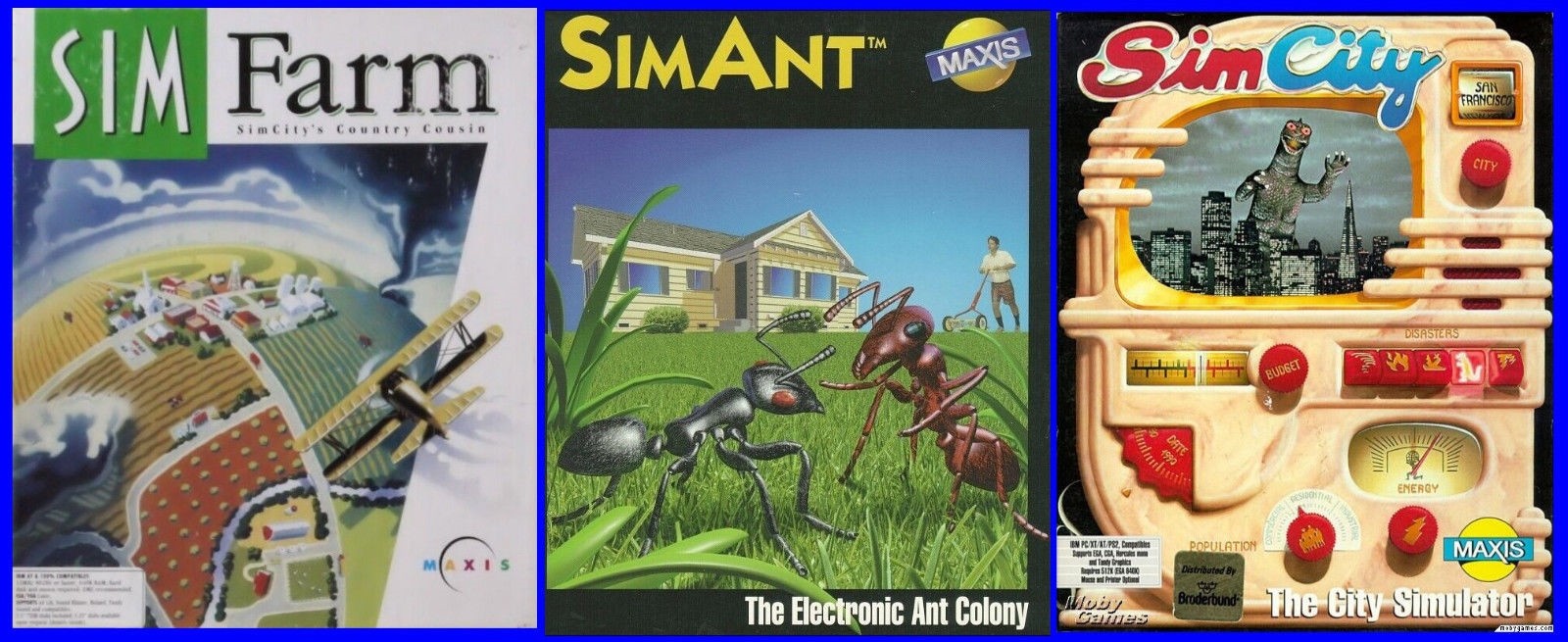
Sim Farm
Sim Ant
Sim City
1-Click Install
Windows
11, 10, 8, 7, Vista, XP
(Maxis 1996)
MY PROMISE
My games are genuine, install in one step, look, sound and play in Windows 11, 10, 8, 7, Vista and XP like they did in the old days, or your money back. This is my unconditional guarantee for three years.
WHAT IS INCLUDED This listing includes the original game CD. On-screen printable manuals for all games are also included. The game boxes are pictured for reference and not included. The jewel cases are also not included.
I will also provide a compatibility CD that will allow the game to run under ALL VERSIONS of Windows 11, 10, 8, 7, Vista and XP, both 32 and 64 bit.
INSTALLATIONOne step: Insert my CD and the games will automatically work on your computer. Done. Yes, it's that simple.
Want to play? Click the icons. Want the games off your computer? Click Uninstall. Zero hassle.
TECH SUPPORT Rapid response technical support for three years is always an e-mail or phone call away.
In the extremely rare event I cannot get this title to work on your system I will take it back for a full refund. All I ask is minimal assistance from you during the troubleshooting process.
The Games
SIM FARM
With the similar idea and control of a Simcity game, this game allowed you to plant any type of crop you could imagine, each one having advantages, whether it be high selling price, or just low maintenance that require no pesticides, herbicides or fertilizer. Almonds for example, are a cash cow once you kill all pests and weeds, that require no work to keep alive and would reap huge profit). And profits would be much higher if you build silos to store the crops and sold them when the market got at the high point for that specific crop. Your farm could really be as creative as you wanted it to look, anything you see on a typical farm could be done in this game.
Crops were not the only thing you could do in Simfarm, you could build fences, and have pigs, sheep and cows; they would visibly grow and also reproduce. The only difficulty in having livestock was keeping them fed and watered. Even though water tanks would help refill the water pales, it didn't work well enough to make it worth trying to make a farm profit this way. Crops were the only way to make big money with little effort.
One other thing that just didn't work right was buying farm equipment such as tractors, plows, harvesters etc. Buying any of this would never harvest your fields on time, and also they broke down fast. The way to avoid this entirely was just to ignore buying any equipment, and the game would automatically rent equipment to spray, and harvest your fields.
You couldn't really win this game, which is no surprise since you really don't win in Simcity. But whenever I played it, I tried to buy land up as fast as possible, and winning this game always felt to me when you had bought up all possible land. Also a visible change in your farmhouse happened as you gained more cash. Graphically this game was very well done for its time and it's interface was smooth.
SIM ANT
Yes, you're an ant. A black ant in a new colony.Your mission is to spread the colony beyond the single piece of the yardthat you're in to take over the entire yard, without the owner of thehouse mowing, exterminating, or otherwise removing you. In case that wasn't enough, there's also a colony of red antsthat's trying to do the same thing. Black and red ants share the samelove as Kurds and Iraqis, and will kill each other at any opportunity.Finally there are the natural hazards such as spiders, ant lions, rainand the like. All in all, a dangerous universe.
You can take control of any of the black ants, whereupon you turn yellowto distinguish you from the rest. If the ant you're using dies (usuallybecause a spider sucked your insides out) you just take over another.As long as one ant is left, you're immortal. You have the ability tocall together groups of ants and lead them on expeditions to wipe outmarauding spiders or enemy colonies. And then there are all the othercomplexities to deal with.
Let's face it, you can't deal with individually managing each one ofhundreds of ants in dozens of colonies, so the computer runs them,meaning that you aren't in control, except for the groups of ants you'releading in attack. However, even though you don't micromanage, you cancontrol the overall direction. You control the breeding ratio ofworkers, fighters, and breeders. If you are about to make a majorattack you'll want more fighters and breeders (to make more fighters),and if you're busy expanding you'll want a lot of workers. Thenthere's the choice of how many you want digging, nursing, and foraging.You can have the computer control both of these choices for you, or youcan do them manually, adding a little difficulty to the game.
However, that's just one little part of the yard. There are 154 ofthose little squares, and your mission is to conquer them all. And thenthere's that strange huge structure on one side of the wall with thatbig two-legged and four-legged monsters living there... Now this is thelong involved game that Maxis was famous for!
And that's even more information to manage - what's going on at all thecolonies, and what's going on overall. The yard view is especiallyentertaining, as the man and dog actually do things, sort of like withthe Little Computer People Project. The guy mows the yard, sits andwatches TV, gets food from the fridge and eats it, etc., and makes theselittle comments.
Okay, now you have your nest windows, your behavior windows, youraboveground window, your yard window, your history window, and all sortsof option buttons. This thing must be harder to use than a stealthfighter! Well, not really. It's as hard as you want it to be. Maxishas refined its interface to the point where you can get all thatinformation is easily usable and interpretable format. All the commandbuttons have meaningful pictures on them that represent the command (thebutton to show you the inside of the black nest has a picture of a nestwith black tunnels), and you can always hit the "?" button, which willoverlay the window with a meaningful description of all the buttons. Ifyou don't want to worry about behavior or breeding, set them onautomatic and close the windows. If you're not in a full game, justclose the yard window. If the history window doesn't help you, closethat. You can get away with just the overhead map and the ground detailwindow.
As you can probably tell, if you're into detailed simulation games, Maxis did itagain with SimAnt.
SIM CITY
Heresville, 1900. An empty landscape and $20,000 in cash presents a new beginning. A chance to build something grand, a New New York, or Chicago, or Boston, but better. A city with thousands no, hundreds of thousands of happy people enjoying low taxes, minimal traffic, low crime, quality mass transit, and affordable housing. Oh, and a wildly popular mayor -- you.
Such is the promise of Sim City. The first popular "God Game", Sim City took the world by surprise and then by storm when it was released by Maxis. Sim City was one of the first open-ended games in that there’s no way to win, and in some sense, losing is also impossible. The goal is simply to build the best city possible, where best refers to the population. 10,000 inhabitants is a good start; 50,000 a worthwhile town; 100,000 an impressive city; and 500,000 nearly impossible. That’s not all, though, since the game shipped with six additional scenarios that combined emulated versions of real cities with an assortment of natural and unnatural disasters, challenging players to respond to those disasters in a limited amount of time and rebuild each city to its original greatness or better.
Sim City was born from the tools used to build a Nintendo game, Raid of Bungeling Bay, which was published in 1985. The game involved a helicopter attack on a series of islands and was largely a standard combat fighter. It wouldn’t be more than a footnote in history except that one of the designers, Will Wright, decided to take the tools that he used to construct the islands for the game and try his hand at building a complete game of his own. Wright’s interest in urban planning combined with his island editor and with buildings, transportation, and power added, the result was Sim City.
Wright worked on Sim City on his own for a year. He shipped a version for the Commodore 64 in 1987, but without funds for marketing or any backing from publishers (who couldn’t understand how it would work as a game), sales were slow. Defining a new genre is quite a challenge, especially for designers working alone. When Wright found a partner, Jeff Braun, and the two formed a company, things started to turn around.
Maxis was created expressly to sell Sim City. Under Braun’s management, Broderbund agreed to co-publish the game in 1989, and the world began to take notice. Initial sales were slow, but word of the game spread and within months Sim City was winning awards and a smash hit. Its success was especially impressive in light of the programming effort behind the game, which consisted entirely of Will Wright. He was the entire design team as well, with Braun handling the business side of things and Broderbund providing enough backing to get the game onto store shelves. The release was simultaneous for both the Macintosh and the PC, and eventually Sim City would ship on a large number of different platforms, from the original Commodore 64 version to the Super Nintendo and even the Palm Pilot.
The game itself either has no story line or an incredibly complex one, depending on the player’s perspective. Unlike almost all other games, Sim City follows no proscribed plot, with each game dramatically affected by the player’s decisions. Those decisions in turn affect the game play itself, as available strategies change based on things varying from the current tax rate to the state of your road infrastructure. In the most common form of game play, the player starts with an empty landscape of trees, lakes, rivers, and dirt, plus a budget of $5000 to $20,000 (depending on a choice of difficulty level). Once the game itself starts, time begins, moving from January 1900 and advancing one month at a time at regular intervals. Meanwhile, the player selects from a variety of city components, from trees and power lines to nuclear power plants and airports, each of which has an assigned cost, and places those on the landscape as needed to form a city. Buildings themselves aren’t so much built as grown, with zones for residential, commercial, and industrial development running $100 apiece.
Naturally, no residents would show up without buildings, so at least a few zonesalways come out of the initial budget. Buildings require power, though, so somewhere inthe budget the player has to find room for a power plant, which can either be the heavily polluting coal ($3000) variety or the clean nuclear plant ($5000). In an attempt to bemore true to form, cost isn’t the only tradeoff between coal and nuclear power theheavy pollution of coal drives citizens away from nearby residential areas while nuclearpower plants are more likely to break down and need to be replaced. Not even a powerplant with power lines ($5 apiece) connecting the plant to the zones is enough to attractresidents, though; the player also had to build roads ($10 apiece) or rail lines ($20).
With those in place, a city starts to grow. Buildings go up, residents move in, andtraffic starts to appear on the streets. Before long, the residents complain of high crime,requiring a police station ($500), and it’s always a good idea to build fire stations ($500)around town as well. As the town gets larger, the residents come to expect things thatother similarly-sized cities have, namely stadiums ($3000), seaports ($5000), and themost expensive item in the game, an airport ($10,000). All of that adds up to more thanthe city’s initial budget, but the game includes a yearly budgeting process where theplayer sets the tax rate while collecting the previous year’s taxes and deciding whatportion of the police and fire budgets ($100 per station per year for full funding) andtransportation budgets ($1 per square per year) to fund. Finding the precarious balancebetween funding for municipal services, tax revenues, and spending towards growth isthe fundamental challenge of the game without a delicate balancing act there, residentsleave when the taxes are too high or development ceases when spending falls too low.
What makes the game interesting is not its graphics, which have never blazed a trail and started out in black and white (and are still black and white on certain Palm Pilot versions, for example) or its music, or any of the visible technologies often noted ingames in other genres. Rather, the artificial intelligence the quality of the simulation is the core of the entire game. It would have been tedious if year after year of a 7% taxrate, patterned zoning, and standard police and fire coverage the population continued togrow, and to make matters worse, that would not have been realistic. Instead, everysingle move that the player makes has an effect on the outcome. Don’t build enoughmass transit, and traffic gets so bad that residents leave. Build residential areas next tohigh-pollution industrial complexes, and houses won’t be built. Ignore the businessesthat clamor for a seaport and watch as commerce decides that another city will be morereceptive and leaves. Of course, keeping people happy requires spending a lot ofmoney but raise taxes to pay for the improvements and watch the population drop. Orleave taxes the same but underfund police and fire services and watch the crime rateincrease or a small fire take out multiple city blocks.
Though the interface may have fallen short of other popular games of the era, the game design was superb. No two games of Sim City are ever the same, or even close to it with every action and reaction having some unknown element of randomness, the result is a product that was infinitely replayable. It is unclear if the difficulty level chosen at the start of each game affects game play itself or merely changes the initial city fund, but without any explicit way to lose (and with a cheat code for acquiring an additional $10,000 so widely known that it was mentioned in a newspaper review of the game), players of all levels can play and enjoy it. The challenge is as much as each player makes of it, since there is no time limit, and the game rarely introduces overt stumbling blocks like natural disasters to cities that aren’t large enough to handle a blow.
While it is possible for players of all skill levels to enjoy Sim City and even build cities of a reasonable size, quite a bit of strategy and advance planning must go into any city to reach 100,000 residents. The game engine takes so many factors into account from the distribution of zones by both number and location to the positioning of individual zones by water, the availability of parks, and the number of buildings that can be supported by each power plant (and each type of power plant) that successful cities require good design from the ground up. They also cannot succeed without successful budget management, some flexibility in the initial design for rebuilding when plans for a specific area fail, and a bit of luck in avoiding serious disasters. Part of the joy of the game is that any player can rise to the challenge with enough effort and thought, the strategy and planning can be learned and improved, and, most importantly, refined by creating city after city. There is no physical skill involved.
Sim City is the epitome of a classic game. It defined a genre, bringing the art of simulation into game design and inspiring later efforts like Sid Meier’s Railroad Tycoon and Civilization. The design was wildly successful; the significant effort that was put into the sim itself created such a captivating game that critics and players alike didn’t care about its graphics. Playability and excitement mattered much, much more,and Sim City’s achievements with each of those kept copies flying off of store shelves. Of course, the ability to remake the world just the way you want it didn’t hurt, either especially if you felt like sending a giant monster through downtown Tokyo in 1957 or just creating the town of your dreams.
Note: My compatibility CD does not alter the retail game or bypass copy protection. It allows the original media to install and run correctly on any recent version of Windows.