When you click on links to various merchants on this site and make a purchase, this can result in this site earning a commission. Affiliate programs and affiliations include, but are not limited to, the eBay Partner Network.
Offered here is an exceptional original 1814 handwritten Pennsylvania-German public sale notice, or “Bekanntmachung,” concerning the estate and real property of Pvt. Andrew / Andreas Morr (1727–1801), an early German-American pioneer, substantial central Pennsylvania landowner, Lutheran church benefactor, and veteran of the American Revolutionary War.
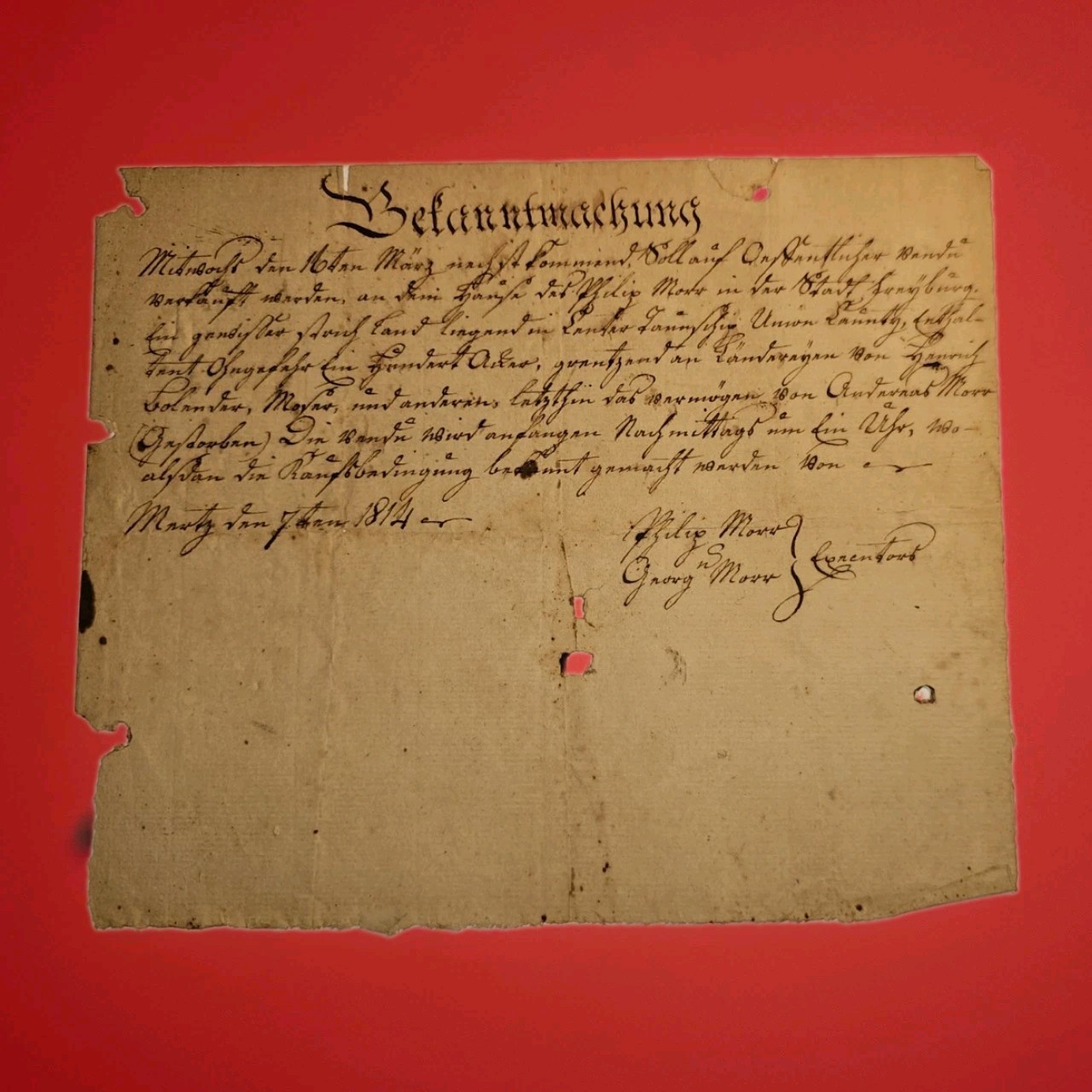
Entirely handwritten in German in an early Kurrent-influenced hand, the document announces the public vendue of an approximately 100-acre tract of land in Centre Township, Union County, Pennsylvania.
It is dated March 7, 1814 and announces the sale for Wednesday, March 16, 1814, beginning at 1:00 p.m.
Most importantly, the document is signed at lower right by:
Philip Morr
Georg / George Morr
with the two names joined by a manuscript brace and identified in English into the Morr family and Andrew Morr’s surviving probate record provides an unusually strong historical context for these signatures. Andrew Morr’s will specifically appointed his sons John George Morr and Philip Morr, along with George Motz, to act as executors. John George and Philip both appeared when their father’s will was admitted to probate in 1801.
The two signatures on this 1814 notice therefore appear to be those of Andrew Morr’s sons Philip and John George Morr, still administering or disposing of real estate belonging to their father’s estate more than a decade after his death.
The document opens with the large, boldly calligraphed German Announcement or Public Notice.
The body announces a sale by öffentlicher Vendue, or public sale, a distinctly Pennsylvania usage reflecting the widespread practice of selling estate property publicly.
The tract is described as lying in:
Centre Township, Union County
and appears to contain approximately:
100 acres
The description also identifies neighboring landowners, apparently including Henrich / Heinrich Bolender and a member of the Moyer / Meyer family.
Those names are particularly interesting because the Morr, Bolender, and Moyer families were part of the same closely interconnected Pennsylvania-German settlement community, and Andrew Morr’s own family had marital ties to both the Bolender and Moyer families.
Andrew Morr, also recorded as Andreas Morr, was born in Germany in 1727 and became one of the notable early German settlers of central Pennsylvania. He established himself in the region that later became Snyder County and accumulated substantial landholdings.
He was also associated with the early Lutheran community near present-day Freeburg. The Morr family became closely connected with the church historically known as Morr’s Church or Zion-Morr, and the Morr name remains associated with the historic cemetery there.
Andrew Morr also served as a private in the Pennsylvania militia during the American Revolution, including service connected with the Lancaster County militia. His Revolutionary War service gives this document an important military and patriotic association even though the manuscript itself dates from 1814.
Andrew died in 1801, but his will specifically empowered his executors to sell real estate and execute deeds to purchasers. The fact that this public sale notice dates from 1814 is therefore entirely consistent with the continued administration or later liquidation of estate property.
The document is especially significant because it appears to represent the actual process by which Andrew Morr’s sons were carrying out their father’s testamentary instructions concerning family land.
Philip Morr, born in 1766, was one of Andrew Morr’s sons and was specifically entrusted with responsibility for the estate. His name appears prominently at lower right in what appears to be his original manuscript signature.
The second signer, Georg Morr, is very likely Andrew’s son John George Morr, born in 1761. John George was also associated with Revolutionary War service and later became a substantial Pennsylvania landowner. He acted with Philip in administering their father’s estate and is listed in Andrew Morr’s will as one of the men empowered to sell real property.
The appearance of Henrich Bolender in the boundary description is especially noteworthy because Andrew Morr’s daughter Magdalene / Mary Magdalena Morr married into the Bolender family.
Likewise, the Moyer or Meyer name has direct family significance. Andrew Morr had daughters who married into the Moyer family, creating a documented network between the Morr, Bolender, and Moyer families.
This means the boundary wording may preserve more than simple adjoining property names. It appears to reflect the actual physical proximity of related Pennsylvania-German families living and farming near one another in early central Pennsylvania.
The geographic setting is also historically important.
The property is explicitly described as lying in Centre Township, Union County, Pennsylvania.
Union County had only recently been created from Northumberland County in 1813. This notice is dated March 1814, placing it within roughly the first year of Union County’s existence.
The historic Centre Township area associated with the Morr family later became part of Snyder County, Pennsylvania, making the document relevant to both early Union County and Snyder County history.
Andrew Morr himself had lived and died while the region was still part of Northumberland County. By the time his sons advertised this tract in 1814, the political geography had changed, and the property was now formally described as lying in the newly created Union County.
The document therefore captures a transitional moment in the administrative history of central Pennsylvania.
Approximate den 16ten März nächst kommend, soll auf öffentlicher Vendue
verkauft werden, an dem Hause des Philip Morr ...
ein gewisses Stück Land liegend in Centre Township Union County, enthält
ein hundert Acker; grenzend an Ländereyen von Henrich
Bolender, Moyer, und andern ... von Andreas Morr
[gestorben]. Die Vendue wird anfangen Nachmittags um ein Uhr, wo
alsdann die Kaufbedingungen bekannt gemacht werden von
März den 7ten 1814
Philip Morr
Georg Morr
Executors
A few words remain difficult to read with absolute certainty because of the period Pennsylvania-German handwriting, but the date, approximate acreage, township, principal names, and executor designation are substantially clear.
English summary:
On Wednesday, March 16, 1814, a public vendue was to be held involving approximately 100 acres of land in Centre Township, Union County, Pennsylvania, associated with the estate of the deceased Andrew / Andreas Morr. The tract adjoined lands belonging to members of the Bolender and Moyer families and others. The sale was to begin at 1:00 in the afternoon, at which time the terms of sale would be announced.
The notice was issued and signed by Philip Morr and George Morr as executors.
This is considerably more than a generic early American sale notice. It appears to be a surviving estate real-estate advertisement issued by two sons of Revolutionary War veteran and Pennsylvania-German pioneer Andrew Morr, carrying out authority explicitly granted to them in their father’s will.
The document combines:
Pennsylvania German history
Revolutionary War family history
Andrew / Andreas Morr genealogy
Philip Morr original signature
John George Morr original signature
Early American land records
Estate and probate administration
Bolender / Bollender genealogy
Moyer / Meyer genealogy
Early Union County history
Present-day Snyder County history
Freeburg-area pioneer settlement
Lutheran church history
Condition is commensurate with a working manuscript more than 210 years old. The document shows overall age toning, historic fold lines, several small holes, edge losses, scattered staining, and minor weakening along folds. Despite these faults, the manuscript presents extremely well. The large decorative “Bekanntmachung” heading remains especially attractive, the body text is substantially legible, and the Philip Morr and Georg Morr signatures remain clearly visible at lower right.
A compelling and highly researchable survivor from one of central Pennsylvania’s prominent early German-American families, with strong appeal to collectors of Pennsylvania Dutch history, Revolutionary War material, genealogy, early land documents, Union County, Snyder County, and the Morr family.