When you click on links to various merchants on this site and make a purchase, this can result in this site earning a commission. Affiliate programs and affiliations include, but are not limited to, the eBay Partner Network.
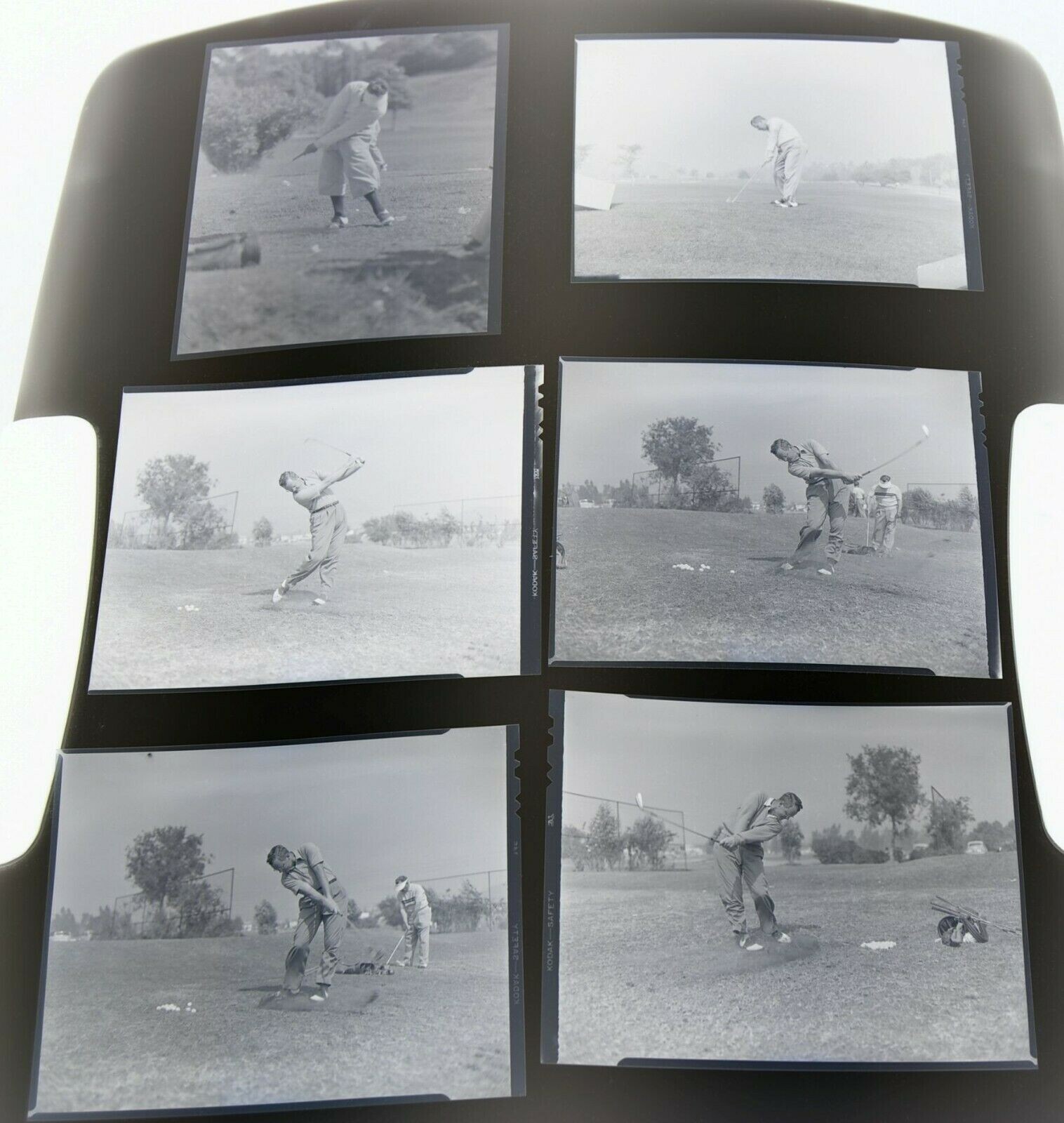
A FANTASTIC COLLECTION OF PHOTOS AND NEGATIVES BY LEGENDARY GOLFER AND INSTRUCTOR ALEX J. MORRISON
There are 11 photos 8 negatives and 3 Alex Morrison paper articles. Many photos are stamped with Alex J. Morrisons stamp.*** Alex Morrison was a golf instructor. His students include Henry Picard who taught Jack Grout who was Jack Nicklaus’s enduring coach and mentor. Morrison was one of four brothers who were all golf professionals in the 1920s, 30s, 40s and 50s. Morrison\'s teachings are credited with helping many golfers reduce their handicap. His book A new way to better golf is one of the #1 golf instruction manuals ever createduring the late-1930s, while working at Hershey Country Club in Hershey, Pennsylvania, my father’s aptitude for playing and teaching the game improved as did his status on the PGA Tour. Certainly, his day-to-day association with Henry Picard helped him a lot in this regard. For sure, the two men spent countless hours together on the practice tee.
It was during those practice sessions that my father, for the first time in an intensive way, was exposed to the philosophy of another great student of the swing. Picard began passing along “secrets” shared with him by one of the most respected golf theorists of the day, Alex Morrison. Picard had been under the aegis of the West Coast swing doctor since the summer of 1935.
Morrison felt that golf was 90% mental, 8% physical, and 2% mechanical. By the 1920’s, he had become a noted teacher and exhibition golfer traveling the vaudeville circuit. Stage entertainment was the perfect fit for a man who favored multi-patterned sweaters, bright argyle socks and had the nervy showmanship to smash golf balls off a man’s head. Still, Morrison was a serious instructor, who prided himself on using “impersonal, scientific” principles and state-of-the-art films of famous golfers to demonstrate technique. Morrison was the first person to make extensive use of a high-speed camera to film the golf swing. At his Southern California base of operations on Catalina Island, his clientele included Charley Chaplin and Douglas Fairbanks – Bob Hope and Bing Crosby frequented his driving range in New York City. Morrison authored two books on golf instruction; A New Way to Better Golf by William Heinemann LTD London, England and “Better Golf without Practice” by Alex J. Morrison Simon and Schuster New York * 1940.
While doing extensive research for my book “Jack Grout: A Legacy in Golf,” I was fortunate to receive the following information about Alex Morrison on Wednesday, June 10, 2009 from Adrian Whited, Club Historian at Los Angeles Country Club:
I was privileged to meet and have a four-hour recorded conversation with him (Alex Morrison) shortly before he died September 25, 1986 at age 90.In 1908, at age 12 or so, he started caddying at The Los Angeles C.C., when the Club was located at Pico and Western. In 1910, he was still caddying and going to school (Manual Arts High School).In 1911, the Club relocated to our present location where Alex continued to caddie for a time. He did assist the golf professional by cleaning clubs, oiling shafts, etc.As far as I know, Alex was never a Club employee. He was a friend of many members and was a guest at the Club whenever he was in the area.One story Alex told me was when the Club leaders asked him to hit shots to help locate some holes, and to help verify the playability when the course was redesigned in 1920. They called him “Slats” (very thin) and fellows would say “Hit it Slats, see if you can reach it” etc…In the 1920’s, he had become a noted teacher and exhibition golfer traveling the vaudeville circuit. He told me his brother George was a better golfer.Alex also wrote several books (the last in the early 40’s) and was the first to use a high-speed camera to film the golf swing (on Catalina Island). He was friends with and taught many movie people. In fact, he was still teaching Claude Aikens when we met in 1986. I met Aikens later and he spoke very highly of Alex.Morrison told me that Henry Picard started taking lessons from him in 1935 or so, and Alex continued to be his mentor for several years. I have read where Picard gave Alex much credit for the resurgence in his career and resulting large number of wins; including The Masters, in the late 1930’s.I understand your father learned from and was influenced by Picard. And, I know that your father taught Jack Nicklaus. From reading and observing, it appears Nicklaus flattened his swing (1980) towards the end of his tour career which is part of what Morrison had taught.
Alex J. Morrison is a golfer whose pro record is qualification in itself for his theories of correct form. But even among golf pros he is one of the few who has cut through the mists of endless speculation and experiment and emerged with simple, clear-cut and adoptable suggestions for the club swinger, be he duffer or champion. One of the most interesting facts about any good pro is his constant devotion to improving his own form, even while he is winning cups. This is what made Bill Talbert so valuable to our Davis Cup tennis players just before they took back the Cup last winter: champions like Vic Seixas and Tony Trabert are capable of strokes which leave the ordinary club player breathless just watching them, much less chasing the ball. Yet Talbert and Seixas and Trabert worked endlessly to reline their form until they hit a peak on the day of the match. Ted Williams of the flawless batting form took thousands of practice swings without worrying about a ball; expert fly-casters practice endlessly with. out going near the water. Just as seriously, top tournament golfers check each other for the little nagging errors that can spoil even the swing of a master. But even more seriously, they dig and dig to keep the very fundamentals of their game as mechanically sound as possible-they prac tice endlessly on balance, posture, even state of mind while playing. And it is these fundamentals of the game-without which you\'ll never break par or even break into a smile-which Alex Morrison has magically and simply short.cutted here for you so as to improve your game without going through all those tedious hours of practice.
INTERVIEWING ALEX MORRISONBy GRANTLAND RICEAlex, I know, as a result of your reputation as a teacher and the tremendous saleof your very fine golf book, that you getqueries from all over the world about allparts of the swing, I also believe that youtake the teaching of golf more seriouslythan anyone I know. You\'ve had so muchexperience in analysing the swing and havebeen so successful, when it comes to correcting faults, that I\'m sure you can giveus some helpful pointers. Tell me, wheredo you think the average golfer should begin in the matter of improving his game?MORRISON:In order to improve his game the playerroust first learn to picture the swing as awhole, not as a series of separate actions.RICE:It seems to me that you\'ve said this samething many times in your articles in THEAMERICAN GOLFER and in your book, and,along with this statement, you\'ve given aperfectly clear description of the entireswing, one that should enable anyone tovisualize the whole swing but, in spite ofthe thoroughness with which you\'ve coveredthe details of body, arm and hand action,there seems to be something still lacking.I know of many cases where, even thoughAlex Morrison points out that there arcthree cardinal points which contribute tothe successful golf swing, all of which mustbe present in every smooth, rhythmic, welltimed stroke.Standing just as erect as possible immediately encourages, and will in time bringabout proper body action and balance.Keeping the head from turning with thebody affords a free shoulder and arm action, and helps to balance and to time theentire body movement.Placing the hands on the club at approximately the same angle makes possiblethe required unison of wrist action. Thetwo lower drawings bring out what is meantby having the hands applied at approximately the same angle at the moment of impactjoy this feeling of smoothness and ease mostof the time instead of occasionally.MORRISON :Oh, there\'s a simple enough means to thisend. In fact that\'s where the trouble comesin; the very simplicity of the suggestions Iam about to offer makes the average playerhesitate about following them. At least Ihave found it so with my own pupils. WhenI suggest that they give their entire attention to just one or two points during theswing, they will say to me, \"It\'s all very wellfor you to tell us to keep our minds on ourchins, but what about our hips, shoulders,elbows, etc. ? What should we be doingwith them in the meantime?\"At the risk of being considered. impoliteI ignore such questions as long as I can.When forced to, I tell them, as I did at thebeginning of their lesson, that, by simplygiving their entire attention to the one ortwo points I stress, they will automaticallybring their shoulders, hips and legs into theproper action. (Continued on page 37)7RICE :Yes, I remember that you originally described the successful swing as being one,full, smooth-flowing motion without mentalor physical interruption, and I think thisvery accurately describes the feeling whichevery player has, when he is at the peak ofhis game, when he is able to swing with littleor no effort, when every move he makes seemsto blend into one flowing motion. And that\'sexactly what I and perhaps a few millionothers would like to know, just how to enhe knows how the swing should be made,the player seems to be quite unable to execute it. How do you account for this?MORRISON:Just as I said before, the swing must at alltimes be treated as a whole or one continuousmotion. I, too, know of any number of players who are able to describe orally nearlyevery move that should be made by the various parts of the body throughout the swing.In addition to having memorized descriptions of the correct movements, they mayeven be able to execute them in a practiceswing, but they fall down when it comes toblending the various stages of the actioninto one uninterrupted motion during actualplay.RICE:F e b r u a r y , 1 9 3 337INTERVIEWING ALEX MORRISON(Continued from page 7)thinking about them during his swingfor the reasons stated above. I ask himto give his entire attention to standingas erect as he can, and to keeping hischin pointed back of the ball. I tell him,of course, that by so doing he willminimize the errors in his body actionand at the same time place himself ina position to enjoy the proper actionin his swing as a whole. In otherwords, I am trying to have him usecertain keys which will open the wayto the necessary coordination betweenall parts of his body.Yes, 1 fully agree with anyone whoadvocates simplified instruction, provided, of course, the instructions arepractical. Most of them are not for, asI am trying to point out, they don\'tenable the player to produce a smoothflowing swing.By way of illustrating just what Imean by this, let me tell you about oneor two things which surely will prevent anything like the desired coordination between the various parts of thebody. For example, when a player\'smind is taken up with thought aboutthe forward shifting of his hips during his downswing, he cannot producethe required power in the clubhead,because, in concentrating on the actionof his hips, he is overlooking the action of his arms and hands. Or, if he triesto urge the club forward with hisright side supplying the propellingpower, he will neglect the action of hisbody, proof of which will be had inthe fact that most of his weight willremain back on his right foot insteadof shifting forward to his left by thetime the clubhead strikes the ball. Theplayer may not realize at the time heis making his swing that his body,arms and hands are not coordinatingproperly, but ample proof is always athand in the flight of the ball in casethere is any doubt in his mind.On the other hand, there are several things which the player can thinkabout immediately before and duringhis swing to benefit his swing as awhole, things on which he can concentrate without hurting other parts of hisswing. When I find that a player seeking advice from me has a number offaults in his body action, such as turning his hips instead of shifting themto the side at the start of his swing,dropping his left shoulder during hisbackswing, swaying or bobbing up anddown with the upper part of his body,I begin by pointing out the existenceof these faults; then I explain that heshould not try to overcome them byIn answering that, I must go back toa series of articles that appeared in THE AMERICAN GOLFER along aboutApril, 1929. In one of these articles Ipointed out three main sources of freedom ; three parts of the body that must betaken care of, if anything like muscularcoordination is to be had in the swing.The first is the upper section of thespinal column which affords freedomof action to the shoulders, arms andhands. This source is kept open by theproper pointing of the chin. The second source, which affords freedom ofaction in the legs and feet, is the lowersection of the spinal column. This iskept open by the side motion of thehips. The third source of freedom is inthe wrist joints. This source is keptfree partly by having the hands on theclub at approximately the same angle.Look after these three main sources offreedom and you can always make yourswing one continuous motionI might add that the pointing of thechin is the connecting link, in a sense,between the body and the arms andhands; the one thing that will bringabout some sort of coordination as longas it is kept from turning with thebody during the spring.On the Gavea Golf Club course at Rio de JaneiroMORRISON:Then, you agree with the policy ofBobby Jones, Gene Sarazen and otherexperts who try to do away withthe old complaint of \"too many thingsto remember\" by giving the player comparatively few things to think about.RICE:In other words I have given them whatmight be termed keys to the action asa whole.MORRISON:Well, I can see how that helps tobring about better hip action and bodybalance, but I don\'t see how it canimprove a player\'s arm and hand ac-tion. Tell me just where this mightbenefit the wrist action for instance?RICE:Yes. Standing more erect and concentrating on the proper pointing ofthe chin will help every player no matter what shot he is having difficultywith, particularly the longer shots.MORRISON:Is that one of the suggestions youmake for all faulty body action?RICE:February,1933
About a month before the 1935 Ryder Cup, Picard began a lifelong relationship with one of the early pioneers of golf instruction. Despite the fact that he had won several events in the preceding two years Picard sought out the advice and teachings of Alex Morrison.
Picard took eight days to learn the Morrison system of golf, hitting more than 500 golf balls a day and practicing the distinctive foot roll that was a big part of Morrison’s method until he had bleeding blisters on his feet.
The results were undeniable. Picard, who eventually entered into a contract with Morrison in 1936 to promote the system of teaching, won 21 of his 26 official Tour victories between 1935-39.
Following a thumb injury, after a victory in the 1938 Pasadina Open that forced him to change his grip from an overlapping grip to an interlocking one, Picard went on to even greater heights. Picard won his first major three weeks later at the 1938 Masters Tournament. His first place check was for the sum of $1,500. The 1939 PGA Championship, then played at match play, at Pomonak Country Club came down to a scheduled 36-hole finals match between reigning US Open champ Byron Nelson and Henry Picard.
Alex Morrison was a golf instructor. His students include Henry Picard[1] who taught Jack Grout who was Jack Nicklaus’s enduring coach and mentor. Morrison was one of four brothers who were all golf professionals in the 1920s, 30s, 40s and 50s. Morrison\'s teachings are credited with helping many golfers reduce their handicap.[citation needed]
Morrison is mentioned in Bob Hope\'s Confessions of a Hooker; My Lifelong Love Affair With Golf, First 100 Years; Golf in America, and Golf In the Ozarks.
Morrison was one of the first to use high-speed photographs to analyze golf swings from all possible angles. Through this analysis, Morrison was able to develop the \"Morrison Swing\".[citation needed]
Morrison wrote two books that are now out of print; one of which introduced the concept of centrifugal force in golf swings. His other book called Better Golf Without Practice contained instruction on visualization techniques.
The adoption of the Morrison swing pattern helped to bring about an improvement in scoring in major tournaments during the 30\'s, 40\'s and 50\'s. His methods have influenced many modern golf instructors.[citation needed]