When you click on links to various merchants on this site and make a purchase, this can result in this site earning a commission. Affiliate programs and affiliations include, but are not limited to, the eBay Partner Network.
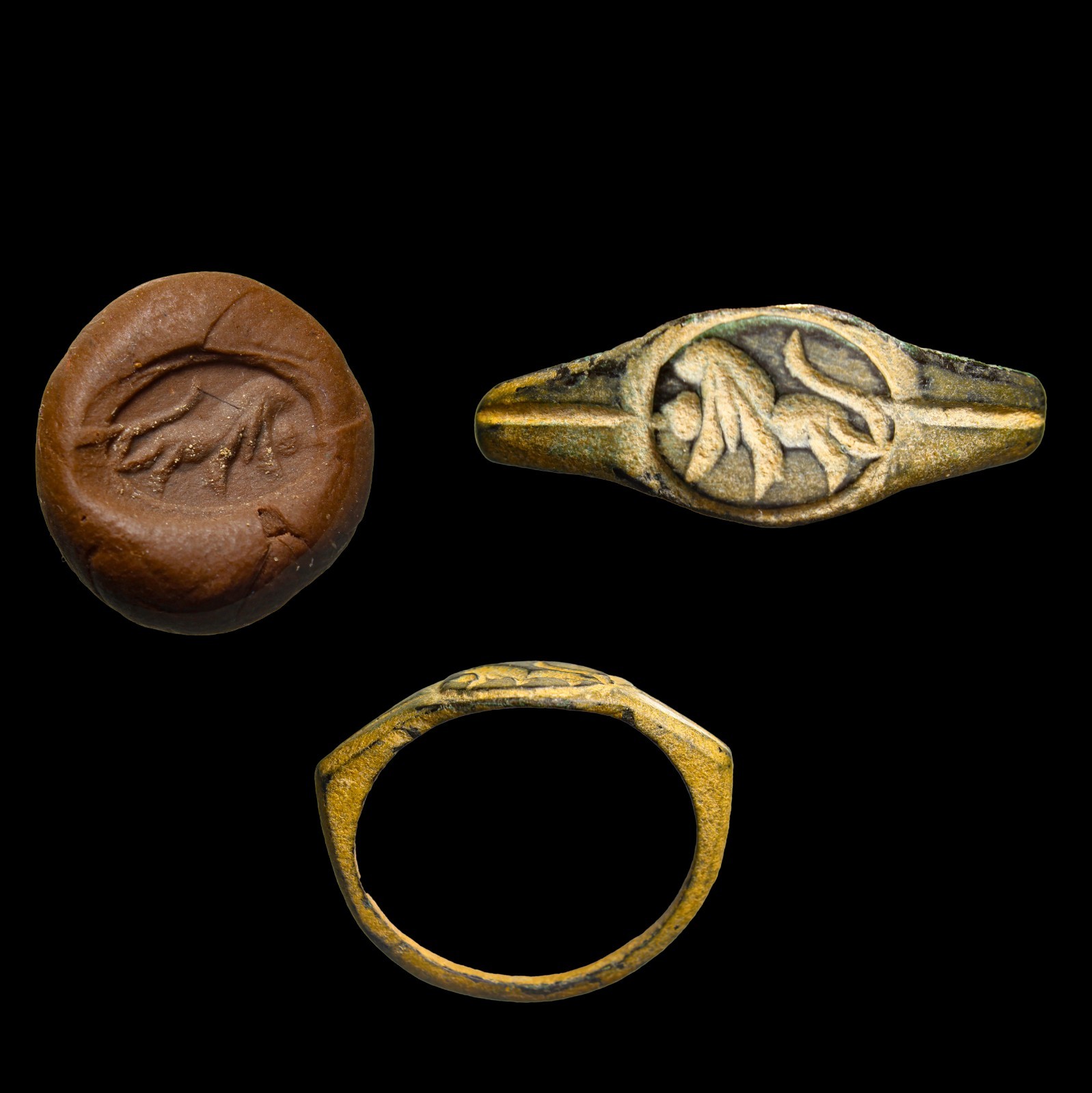
Roman Bronze Geometric Shield-Bezel Signet Ring Authentic
As with all items in this collection, this artifact is certified authentic and comes with a Certificate of Authenticity and Provenance, detailing typology, dating, regional attribution, and collection history.
Item: Finger ring / signet ring
Culture: Roman Empire
Date: c. 1st–3rd century AD
Material: Bronze
Ring Size: approx. US 3.5
Bezel: Shield-form bezel with incised geometric lattice pattern
This Roman bronze signet ring features a flattened shield-shaped bezel engraved with a tightly ordered geometric grid of diagonal and vertical lines. The hoop is slender and slightly irregular, consistent with Roman cast bronze rings intended for daily wear. The surface exhibits stable archaeological patina with oxidation, mineral accretions, and wear consistent with long burial.
Description:
Geometric signet rings were widely used throughout the Roman world as personal seals and identity markers. Unlike figural intaglios depicting gods or animals, purely geometric designs were favored for their clarity when impressed into wax or clay. Patterns such as lattices, cross-hatching, and diagonal grids produced crisp seal impressions and were easy to recognize.
The shield-like bezel form reflects Roman military and civic symbolism, where shields represented protection, authority, and personal status. While not heraldic in the medieval sense, such shapes conveyed strength and identity within Roman visual language. Rings of this type were commonly worn by civilians, merchants, soldiers’ families, and administrative personnel.
The very small ring size suggests ownership by a woman or child, which aligns with archaeological evidence showing that signet rings were worn across genders and ages in Roman society. These rings functioned not only as seals but also as protective and symbolic objects closely tied to the wearer’s personal and social identity.
Authentication:
Authenticity confirmed through bronze composition, Roman casting technique, and ring morphology.
Patina development, corrosion patterns, and wear correspond to excavated Roman bronze rings.
Geometric engraved bezel matches known Roman signet rings designed for functional sealing.
Comparable Examples:
British Museum, Roman Collection, BM 1856,0701.112 – Bronze geometric signet ring
Israel Museum, Jerusalem, Roman Period Collection, Inv. 84.71.19 – Roman bronze ring with lattice engraving
Metropolitan Museum of Art, Roman Art Collection, Acc. 74.51.3568 – Roman ring with abstract geometric seal design
Further Reading:
Henig, M., Roman Intaglios and Engraved Gems, British Museum Press, 2007
Johns, C., Jewelry in the Roman World, British Museum Press, 1996
Boardman, J., Engraved Gems of the Roman World, Thames & Hudson, 2001
Condition:
Good ancient condition. Ring intact with stable patina, surface corrosion, and wear consistent with age and burial. Fully authentic Roman geometric signet ring.
3-5