When you click on links to various merchants on this site and make a purchase, this can result in this site earning a commission. Affiliate programs and affiliations include, but are not limited to, the eBay Partner Network.
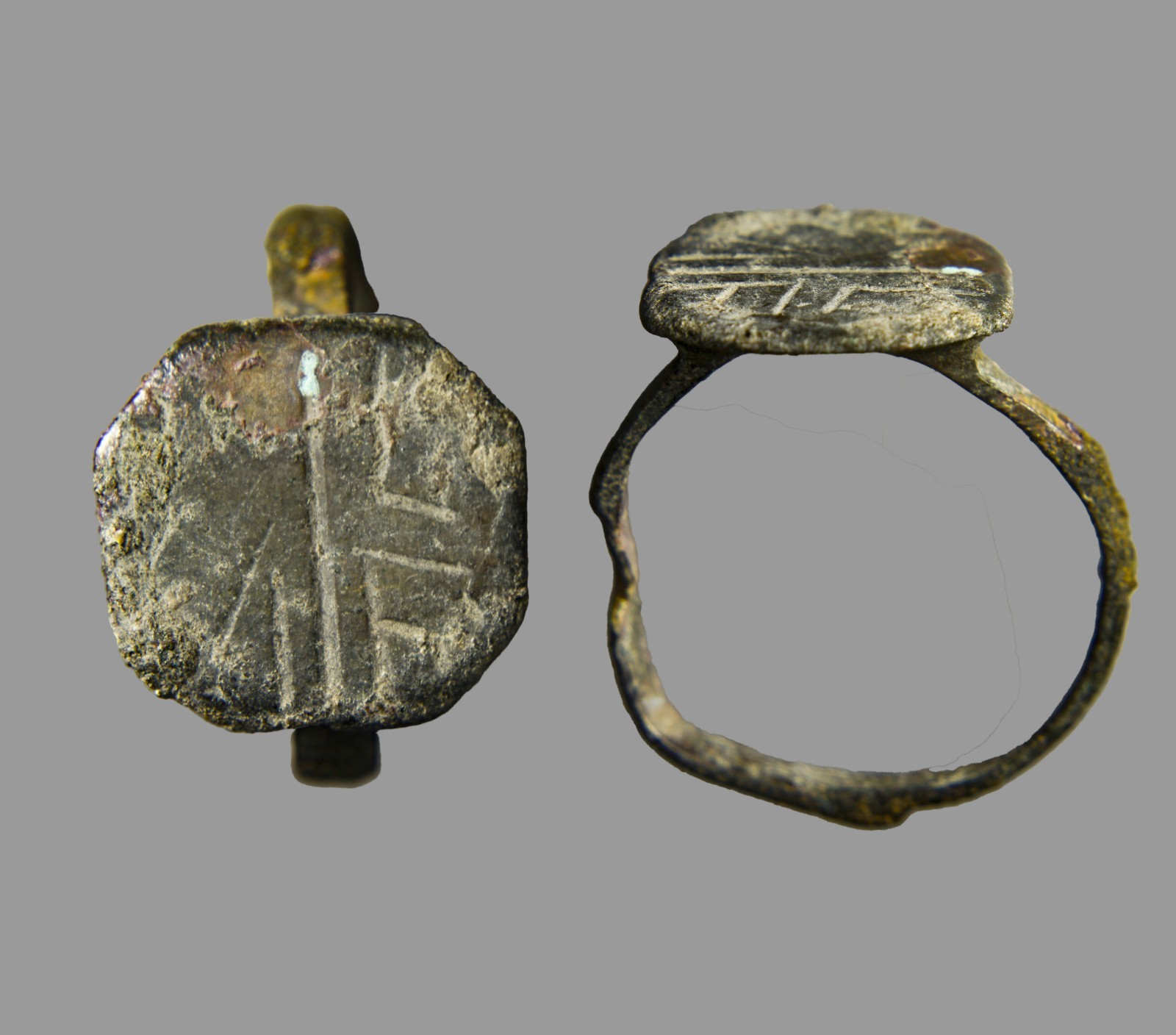
Ancient Levantine / Ancient Hebrew Period Bronze Inscribed Signet Ring (US Size 7.5–8)
Authenticity & Guarantee
Item Specifications
Object: Cast Bronze Signet Ring / Intaglio Inscribed Seal Ring
Culture / Period: Ancient Levant (Iron Age II / Israelite & Phoenician Sphere)
Date Range: Circa 1000 BC – 800 BC (10th–8th Century BC)
Ring Size: US Size 7.5 – 8 (approx. 17.7mm – 18.2mm internal diameter; wearable)
Material: Solid Cast Bronze (Copper Alloy)
Bezel Matrix & Epigraphy: Flat octagonal bezel plate divided by a central vertical field line, bearing incised archaic Palaeo-Hebrew/Phoenician letterform glyphs (Lamed, Shin, Aleph, Taw) arranged in an acrostic protective matrix
Condition: Excellent, structurally sound archaeological state. Slender wearable hoop, well-preserved central vertical divider and incised letterforms, coated in a dark olive-green patina with authentic pale desert-earth encrustation.
Epigraphic Reading & Mystical Context
The Matrix Design & Epigraphic Breakdown
Script Type: Archaic Northwest Semitic / Early Palaeo-Hebrew (Ktav Ivri).
Identified Epigraphic Glyphs: Divided seal layout featuring Lamed (𐤋), Shin (𐤔), Aleph (𐤀), and Taw (𐤯).
Translation / Mystical Meaning: The top-right Lamed functions as the classic West Semitic possessive prefix ("Belonging to..."), while the Shin invokes שַׁדַּי (Shaddai — "The Almighty"). The lower registers feature the Aleph and Taw monogram—representing total divine coverage from beginning to end. In early Levantine seal traditions and esoteric practices, wearing an acrostic ring of this form invoked spiritual protection (Shemirah) against harm while serving as the owner's legal mark on wax, clay stoppers, and trade documents.
Bronze Age to Iron Age Levantine Glyptics
Divided field signet rings featuring octagonal or oval bezels cut with acrostic divine monograms were worn by merchants, priests, and local officials across Judea, Samaria, and coastal Phoenicia (Ref: Avigad & Sass, Corpus of West Semitic Stamp Seals, Israel Academy of Sciences and Humanities, 1997; Naveh, Early History of the Alphabet, Magnes Press, 1987). The natural earthen deposits adhering within the intaglio grooves reflect authentic burial matrix from the arid Judean hill country.
Typological Analysis & Comparable Museum Accession Parallels
Craftsmanship & Construction
Lost-wax cast bronze with hand-cut intaglio engraving across the flat octagonal bezel face. The thin bronze band expands smoothly into the flat matrix plate.
Comparable Archaeological Examples & Museum Accession Numbers
Israel Antiquities Authority / Israel Museum (IAA Inv. 1978-525): Iron Age II bronze signet ring with divided field West Semitic seal face.
British Museum (Accession No. 1888,0208.14): Levantine bronze signet ring with divided matrix and archaic script glyphs.
Ashmolean Museum (Accession No. AN1933.1202): Early 1st millennium BC West Semitic bronze seal ring.
TRN-1-3