When you click on links to various merchants on this site and make a purchase, this can result in this site earning a commission. Affiliate programs and affiliations include, but are not limited to, the eBay Partner Network.
Large Mendi or Wola Worrumbi War ShieldA Monumental Painted Wood Shield from the Southern Highlands of Papua New Guinea
Papua New Guinea | Southern Highlands Province | Nembi Plateau
Mendi or Wola Peoples | 20th Century
LY Brothers Fine Art
Selected Antiquities, Oceanic & Ethnographic Works of Art
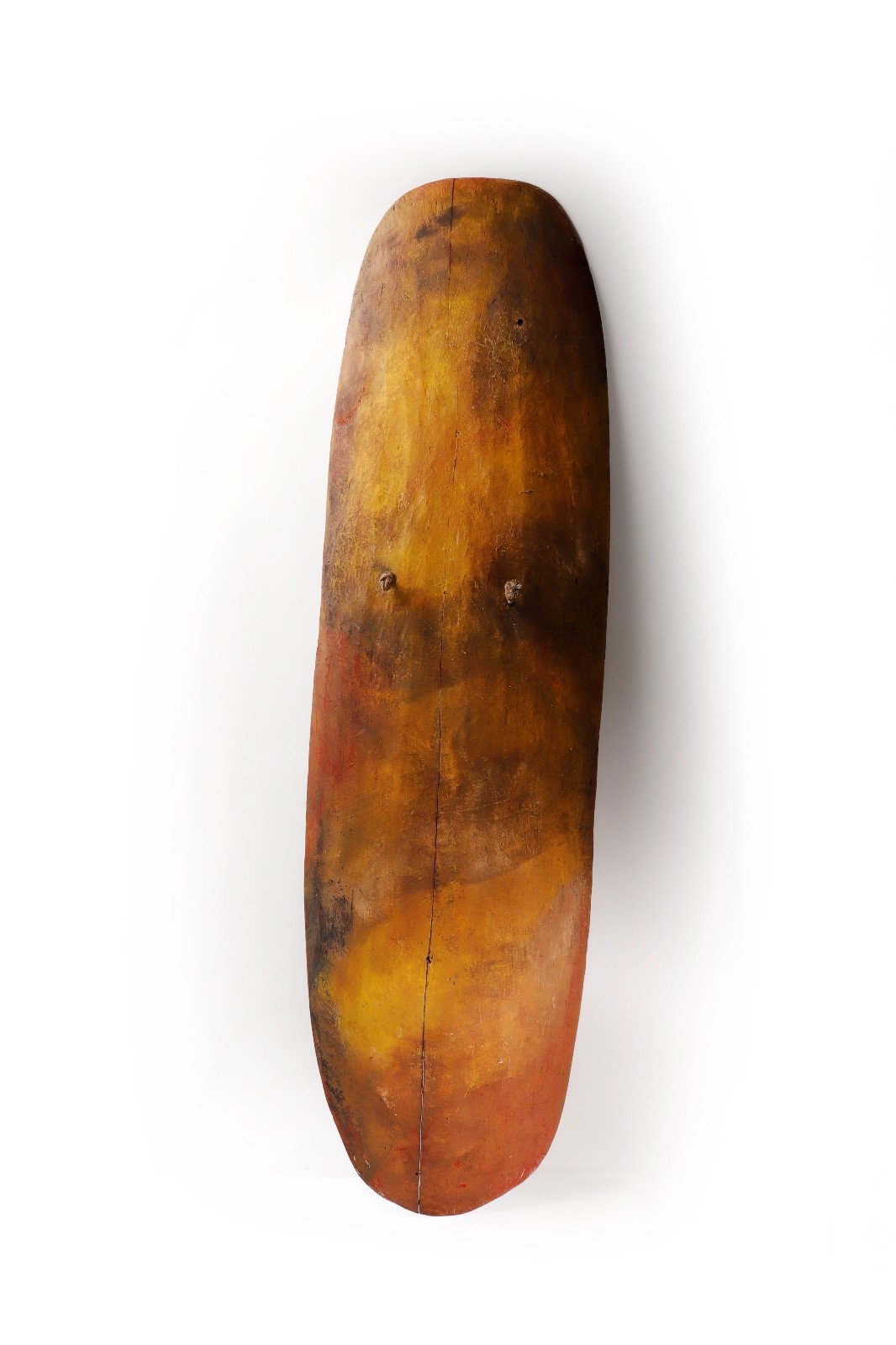
An impressive large-scale wooden war shield of the worrumbi or warrumbi type, traditionally associated with the Mendi and Wola peoples of Papua New Guinea's Southern Highlands.
Standing an exceptional 55½ inches tall, the shield is distinguished by its elongated oval silhouette, gently convex face, and richly weathered surface retaining traditional mineral pigments in warm yellow ochre, reddish orange, and deep brown to black.
Carved from a substantial piece of native hardwood, traditionally identified with the locally named worr or fel tree, the shield combines remarkable sculptural simplicity with the powerful visual language of Highland warfare.
Its narrow, vertically oriented body rises to a softly rounded upper end before tapering gradually toward the base. The surface is animated by broad, irregular passages of pigment that create a remarkably expressive composition.
Golden-yellow and ochre tones dominate the central field, while reddish-orange areas emerge toward the lower portion and along the margins. Darker brown and blackened passages introduce depth and contrast, producing an almost abstract, painterly effect.
Two small projecting elements appear near the central portion of the face, associated with the openings used to secure the carrying apparatus on the reverse.
The shield's commanding scale and bold arrangement of color transform what was originally a defensive implement into an extraordinary work of sculptural art.
Historical and Cultural Context
The Mendi and Wola peoples of Papua New Guinea's Southern Highlands developed distinctive traditions of warfare, ceremonial display, and painted wooden shields.
Among the most recognizable examples are the elongated oval shields known as worrumbi or warrumbi, traditionally carried by warriors during armed encounters.
These substantial wooden shields provided protection from arrows, spears, and other weapons while also serving as visible expressions of the warrior's identity and presence.
The shields were frequently decorated with bold mineral pigments, including red ochre, yellow, white, and black. Such colors held cultural significance and were used to create striking visual effects during confrontations.
The painted surfaces could carry associations with ancestral protection, strength, and the psychological dimensions of warfare.
Unlike purely decorative objects, traditional Highland shields were created for practical use. Their substantial wooden construction and carefully organized carrying systems reflected the demands of armed conflict in the rugged landscapes of the New Guinea Highlands.
Today, surviving examples are appreciated for both their ethnographic importance and their extraordinary sculptural and abstract qualities.
Object Details
Culture:Mendi or Wola
Origin:Nembi Plateau, Southern Highlands Province, Papua New Guinea
Period:20th century
Type:Worrumbi / Warrumbi war shield
Collection:Mendi Shield Collection — Catalog No. 003
Material:Carved native hardwood with mineral pigments and fiber carrying handle
Height:55½ inches (141 cm)
Width:16 inches (40.6 cm)
Provenance
Joshua Diamonstein Collection
LY Brothers Antiquities & Fine Art, Southern California
Condition
The shield exhibits extensive evidence of age, handling, and use.
The painted surface displays scratches, abrasions, pigment loss, scattered chips, and localized areas of wear.
A pronounced vertical age split runs along the central portion of the shield, accompanied by additional surface checking and irregularities in the wood.
The shield is reported to retain its fiber carrying handle on the reverse, threaded through pierced openings.
Wear is present around the handle openings, together with scattered impact marks and perforations that have been described as consistent with arrow strikes. The precise causes of individual marks have not been independently established.
Areas of darker surface discoloration and natural irregularities contribute to the shield's distinctive appearance.
Despite its evident wear, the shield retains its commanding silhouette and substantial areas of original-looking painted decoration.
The surface has not been represented as free from historic intervention or restoration. Please review the accompanying photographs carefully.
Gallery Commentary
This remarkable shield embodies the powerful relationship between sculpture, painting, and functional design found in the artistic traditions of Papua New Guinea's Southern Highlands.
Its monumental proportions and restrained oval form establish an imposing architectural presence, while the surviving mineral pigments create a composition of exceptional visual character.
The subtle transitions between yellow ochre, reddish orange, and deep brown are especially compelling, lending the surface an almost abstract expressionist quality.
The shield's evident age, surface wear, and pronounced central split contribute to its historical character and emphasize its origin as an object made for use rather than simply for display.
At over four and a half feet tall, the work possesses a striking presence that can be appreciated equally within a collection of Oceanic art or alongside modern and contemporary sculpture.
An important visual addition to a thoughtfully curated collection of ethnographic, Indigenous, and Oceanic works of art.
LY Brothers Fine Art
Southern California
Specializing in Postwar California Art, Antiquities & Ethnographic Works.