When you click on links to various merchants on this site and make a purchase, this can result in this site earning a commission. Affiliate programs and affiliations include, but are not limited to, the eBay Partner Network.
What was on the shelf at New York\'s grandest department store nearly a century ago?🗽
There\'s something about a mince meat label that stops a collector cold — it\'s not the fanciest piece of paper ephemera you\'ll ever hold, but it\'s the kind of everyday grocery survivor that almost never survives. Before the pie even went in the oven, before the brandy and spice filled the kitchen, someone at Bloomingdale\'s packed this little label onto a tin destined for a New York City pantry.That it\'s still here, crisp and unused, nearly a hundred years later, is the whole reason we collect this stuff in the first place.
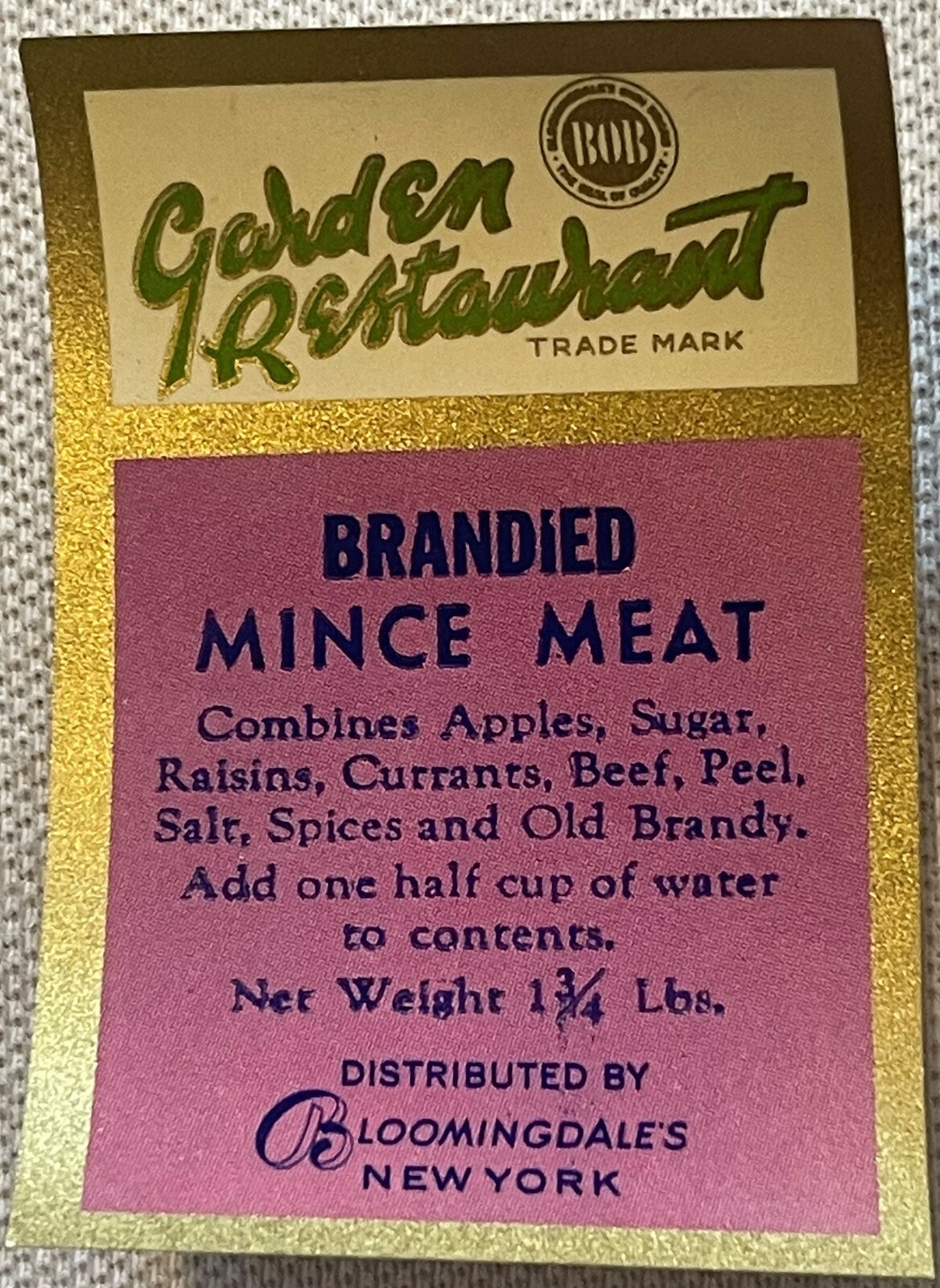
This is an original Garden Restaurant Brandied Mince Meat label, distributed by Bloomingdale\'s, New York, dating to the 1920s–1930s era of American specialty food packaging — the years when a condensed sans-serif headline and a flourish of hand-lettered script were the height of grocery-shelf style.This example is New Old Stock (NOS), meaning it was never applied to a tin and put to use — it\'s simply been waiting, tucked away, for someone who appreciates it. It measures a compact 2.5 x 1.5 inches (approx. 6.4 x 3.8 cm), small enough to sit in the palm of your hand, exactly the scale of a specialty tin label meant to be read in a single glance off a shelf.
The artwork itself is a small masterclass in early 20th-century food packaging design.Across the top, a gold metallic foil border frames a cream-colored panel, where \"Garden Restaurant\" is rendered in a loose, confident green script — the kind of hand-lettered logo that was meant to feel personal, almost like a signature, rather than mass-produced. Beside it sits a round \"BOB\" seal, printed in the same warm brown-gold tone as the border, with \"TRADE MARK\" set in small, precise serif capitals just beneath the script.Below that, the label shifts into a solid pink block, where \"BRANDIED MINCE MEAT\" is stamped in bold, condensed dark navy blue lettering — an Art Deco-influenced style, tall and tightly spaced, built for maximum shelf presence in a small footprint. The full ingredient list follows in the same navy ink: apples, sugar, raisins, currants, beef, peel, salt, spices, and old brandy, along with the preparation note to add a half cup of water, the net weight of 1¾ lbs., and finally, in its own flowing cursive mark, \"Distributed by Bloomingdale\'s, New York.\" It\'s a lot of information packed into a very small space, and the fact that it still reads this cleanly is a genuine treat for anyone who loves early commercial printing.
🏬 A House Brand From the Great East Side Store
Notice the wording on this label very carefully: it doesn\'t say \"made by\" Bloomingdale\'s — it says \"Distributed by Bloomingdale\'s, New York.\" That single word tells a real story.In the great department store era, the big Manhattan emporiums didn\'t just sell dry goods, ladies\' notions, and furniture — many of them also ran their own house-brand grocery and specialty food lines, packed by outside food packers under the store\'s own name and sold as a point of pride to loyal shoppers. A tin of \"Garden Restaurant\" brandied mince meat, distributed under the Bloomingdale\'s name, fits squarely into that private-label tradition — a store using its own trusted name to vouch for a product it didn\'t necessarily manufacture itself, but stood behind all the same.
Bloomingdale\'s itself has roots that stretch back to 1861, when brothers Lyman and Joseph Bloomingdale opened a small shop dealing in hoop skirts and ladies\' notions on the Lower East Side of Manhattan.By the time a label like this one would have sat on a shelf, the store had long since grown into what New Yorkers proudly called \"the Great East Side Store,\" a full-scale emporium on Third Avenue anchoring the neighborhood around 59th and 60th Streets. That decades-long growth from a single storefront into a citywide institution is worth knowing on its own — separate entirely from this label\'s own 1920s–1930s printing — because it\'s the backdrop against which a house-brand grocery item like this one makes complete sense.A store that large, that trusted, wanted its name on everything from fashion to furniture to the family\'s holiday pantry.
🎖️ The BOB Seal and a Trademark Worth a Second Look
That round gold seal reading \"BOB,\" set right beside the Garden Restaurant script, is one of the quiet mysteries that makes a piece like this fun to own.Seals like this were a common device in early 20th-century packaged food advertising — a compact stamp meant to signal quality assurance to a shopper glancing across a crowded shelf, much the way a \"Reg. Trade Mark\" notice or a maker\'s seal did on countless other products of the period. Exactly what \"BOB\" stood for, or who registered it, isn\'t something we can pin down with certainty — no surviving trademark record for it has turned up in general research — so it remains one of those small collector puzzles that comes bundled with the piece.It\'s easy to imagine it as a private mark tied specifically to the Garden Restaurant line, perhaps a packer\'s own quality guarantee, but that\'s speculation worth stating plainly as such rather than dressing up as settled fact. Half the fun of ephemera collecting is living with a question like that rather than a tidy answer.
🍎 Brandied Mince Meat: A Holiday Tradition in a Tin
The ingredient list on this label is a genuine time capsule of old-fashioned American holiday baking: apples, sugar, raisins, currants, beef, peel, salt, spices, and old brandy.This is traditional, meat-inclusive mince meat — the real, old-world version of the dish, built the way English and early American households had made it for generations before \"mincemeat\" quietly evolved, in many modern kitchens, into a meatless fruit-and-spice filling. A tin like this one was meant to shortcut the labor of chopping suet and beef by hand, letting a home cook (or a department store shopper without the time to make it from scratch) simply add water and bake straight into a pie crust — a genuine convenience product wrapped in old-world flavor, sold at exactly the time of year when a New York kitchen would have wanted it most.
Old-timers who remember mince pie as a Christmas-table fixture will tell you the \"brandied\" part of the name wasn\'t just flavor — it was practically a badge of quality, a signal that this wasn\'t a bare-bones filling but a richer, boozier, more indulgent version worth the extra pennies at a store like Bloomingdale\'s.Whether \"Garden Restaurant\" itself referred to an actual dining room somewhere inside or associated with the store is something no confirmed record has surfaced to settle — but the name itself, paired with a holiday specialty food, certainly conjures the kind of genteel, palm-court dining rooms that grand department stores of the era were famous for hosting, where shoppers paused between errands for a proper lunch beneath potted ferns and skylights.It\'s a lovely image to hold onto, even offered here plainly as imagination rather than documented fact.
🗽 New York\'s Age of the Grand Emporium
To really feel what this little label represents, it helps to picture the New York it came from.This was the era of the great Manhattan department stores at the absolute height of their cultural power — Bloomingdale\'s among them — competing not just on merchandise but on experience. These weren\'t simply stores; they were destinations, with elaborate window displays, uniformed staff, and yes, in-house restaurants and tea rooms where the city\'s shoppers, particularly its women, could make a full day of an outing.A specialty grocery item bearing a restaurant-style name and distributed under the store\'s own banner fits perfectly into that world — a small keepsake of an era when a trip to Bloomingdale\'s meant far more than picking up dry goods, and when a store\'s own brand name on a tin of mince meat was as much a mark of belonging to that world as it was a grocery purchase.
🕰️ Why This Little Label Still Matters Today
Grocery ephemera like this survives at a fraction of the rate of the sturdier collectibles from the same era — tins got emptied, washed, and tossed; labels got soaked off or simply thrown away with the trash.A label that never even made it onto a tin, held back instead as new old stock, is a genuine rarity by the very nature of what it is. For collectors of New York City history, department store memorabilia, and early American food advertising, that survival is the whole appeal: a crisp, unused piece of commercial art from a Bloomingdale\'s grocery line that most people assume simply doesn\'t exist anymore.Bloomingdale\'s itself remains one of the most recognized names in American retail to this day, which only adds to the pull of owning a piece from its early grocery history — a small, printed link between the store New Yorkers shop at now and the one their grandparents\' generation knew.
🖼️ Display Ideas
- 🏙️ Framed alone or matted with other early New York City advertising ephemera as a small gallery wall
- 📚 Preserved in a scrapbook or archival ephemera album dedicated to department store or grocery history
- 🍽️ Set out on a holiday sideboard each mince pie season as a nod to old-fashioned baking traditions
- 🎀 Paired in a shadow box with other Bloomingdale\'s paper goods — bags, ribbons, advertisements
- 🕯️ Displayed alongside vintage kitchen tins or canisters on an open pantry shelf
- 🖋️ Shown off among a collection of Art Deco-era lettering and graphic design ephemera
🎁 Who Collects These
This is a piece that pulls from several collecting worlds at once.New York City history buffs and Bloomingdale\'s memorabilia collectors want it for the store\'s own name printed right across the bottom. Vintage food advertising and label collectors prize it for the multi-color, gold-foil lithography and the compact, punchy layout typical of specialty grocery packaging from this period.Culinary historians and holiday-tradition collectors are drawn to the genuine old-world mince meat recipe spelled out right on the label. And graphic design enthusiasts — especially those who love hand-lettered script logos paired with bold Art Deco-influenced typography — appreciate it purely as a small, beautifully composed piece of commercial art.
❓ FAQWhat exactly is \"Brandied Mince Meat\"?
It\'s a traditional, meat-inclusive mincemeat filling — combining apples, sugar, raisins, currants, beef, peel, salt, spices, and old brandy, per the recipe printed right on the label — meant to be prepared with a half cup of added water and baked into a pie, in the old-world style rather than the meatless versions common in many kitchens today.
Is this label new old stock, and what condition is it in?
Yes — this is genuine New Old Stock (NOS), meaning it was never applied to a tin or put into use.It stands as an excellent early example of American specialty food advertising and department-store house-brand packaging from its era, with all its original lithographed color and lettering intact.
What size is the label?
It measures 2.5 x 1.5 inches (approximately 6.4 x 3.8 cm), a compact size typical of a specialty grocery tin label meant to be read at a glance.
Did Bloomingdale\'s actually make this mince meat?
The label states it was \"Distributed by Bloomingdale\'s, New York\" — not manufactured by the store.This wording points to a house-brand or private-label arrangement, common among the era\'s large department stores, where a trusted packer produced the food and the store distributed it under its own name.
What does the \"BOB\" seal or \"Garden Restaurant\" name refer to?
Neither has a confirmed historical record we could locate.The round \"BOB\" seal appears to function as a quality-mark device typical of the era\'s packaged food branding, and \"Garden Restaurant\" reads as the specific house-brand name under which this mince meat was sold — but any deeper meaning behind either remains an open question rather than a documented fact, which is part of what makes the piece fun to own.
How old is this label?
Its lettering style — a hand-lettered script logo paired with bold, condensed Art Deco-influenced typography and gold metallic lithography — places it in the 1920s–1930s era of American specialty food packaging.
Why is a plain grocery label worth collecting?
Because so few survived at all.Labels like this were meant to be used up and thrown away with the empty tin — an unused example like this one, still carrying its full color and original printing, is a genuine rarity from a very ordinary, everyday product that almost nobody thought to save.