When you click on links to various merchants on this site and make a purchase, this can result in this site earning a commission. Affiliate programs and affiliations include, but are not limited to, the eBay Partner Network.
Size: 2.75 x 0.75 inches
What Does a Cigar Band Say When It Never Says a Name at All?🎗️
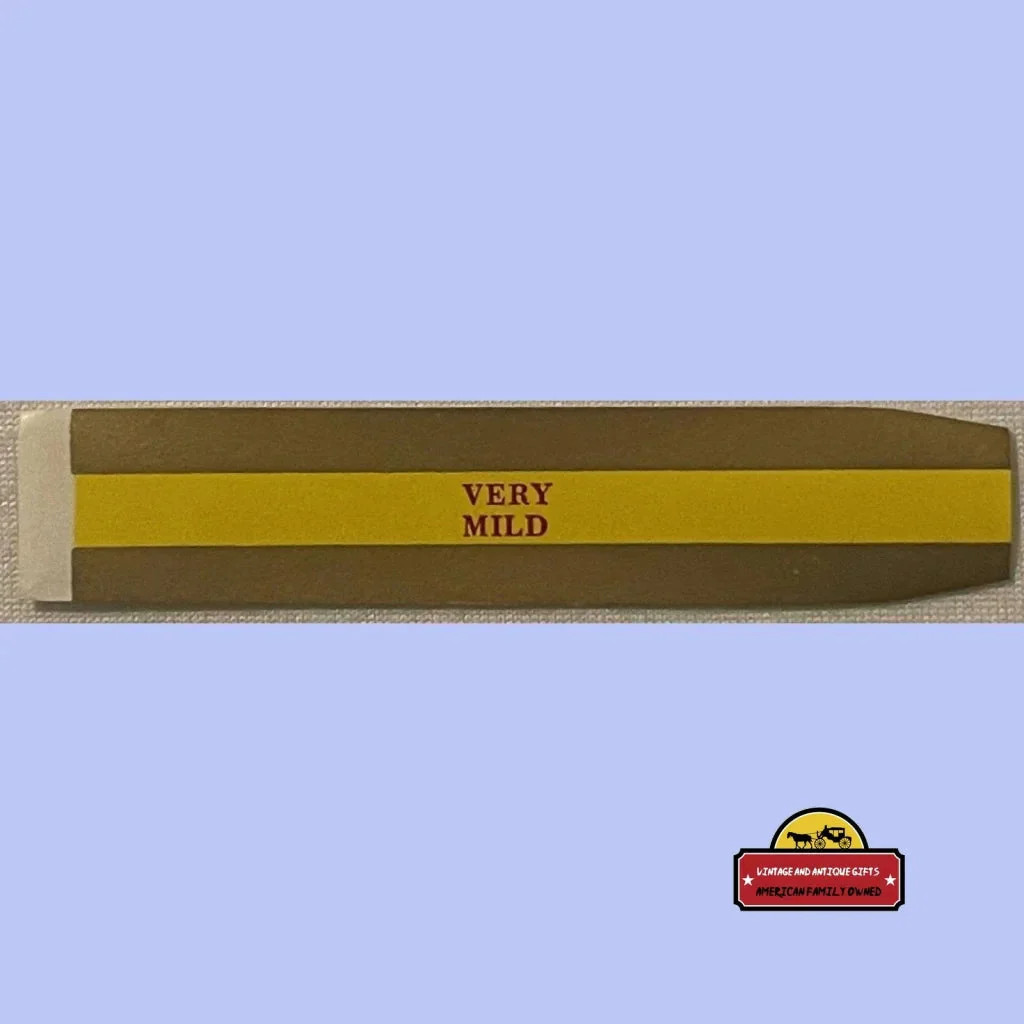
There\'s something quietly touching about holding a piece of paper this small and realizing it was made for a moment that was never meant to last — printed, bundled, cut, and set aside to circle a cigar for the brief seconds between a shopkeeper\'s counter and a smoker\'s hand.No brand blazoned across it. No lithographer\'s signature tucked into a corner. No town, no factory number, nothing to hang a famous story on. Just two words, printed with total confidence: VERY MILD. And that confidence is the whole story. Somewhere, a cigar maker — or a small tobacconist stocking someone else\'s product — believed those two words were enough.And for a long stretch of American history, in a country where a cigar was as ordinary as a cup of coffee, they were.
What you\'re looking at is a cigar band — the small printed paper loop once wrapped around the body of a cigar to identify it — surviving here as New Old Stock, meaning it was printed, bundled, and held in inventory for use, but never actually applied to a cigar.It\'s produced in flat, solid-color lithographed printing typical of tobacco ephemera of its kind: a warm olive-gold/brown field running the top and bottom of the band, a bold yellow stripe down the center, and the words VERY MILD set in deep red serif capitals across that stripe. One end tapers to the pointed shape typical of a band cut and stacked for hand-application; a plain glue edge sits at the opposite end, built for a quick fold-and-paste motion at the factory bench.The reverse is plain, uncolored paper — no printer\'s mark, no brand, no town. Because nothing on the piece names a maker and no manufacture mark survives legibly, I won\'t invent a year for it. What I can tell you, honestly, is that stock descriptor bands of exactly this style were printed and used across a long window of American cigar production — comfortably the early 1900s through the mid-20th century — a stretch during which designs like this one were run off by the hundreds of thousands for factories that never bothered to put their own name on the paper at all.
🚬 Born in Havana: Where the Cigar Band Itself Comes From
Even a band with no name on it carries the DNA of a real invention, and it\'s worth knowing.Cigar historians credit Gustave Bock, a Dutch-born cigar man working out of Havana, with introducing the paper band in the 1830s, ordering rings printed with his own signature to be fitted onto every cigar bound for export to Europe. Lore passed down among cigar historians holds that the custom took root for two reasons at once: so a gentleman handling a fine Havana wouldn\'t stain his gloves with tobacco oil, and so that, at a glance across a smoking room, everyone present would know exactly what he was smoking.By the middle of the 1850s, virtually every Cuban cigar maker exporting abroad was banding their product, and American manufacturers — never slow to borrow a good idea — adopted the practice with real enthusiasm of their own.
🏭 A Nation That Smoked Like It Was a National Pastime
It\'s easy to forget, from where we sit now, just how enormous the American cigar trade once was.At the turn of the twentieth century, historians estimate that something like four out of five American men smoked cigars as a matter of course, and production was scattered across hundreds of factories nationwide, all competing hard for the same smoker\'s nickel. Bands were cheap to produce — on the order of seventy cents per thousand — and by some estimates roughly two billion cigar bands were sold in the United States in the year 1900 alone.In a marketplace that crowded, a band became a tiny billboard, and manufacturers ordered them by the case from shared printers\' catalogs, which is exactly why so many surviving bands from this era — this one included — look similar to one another and carry no name at all. A small or regional cigar maker didn\'t need custom artwork; he needed a stock design that said something useful, ordered the same way from the same catalog as his competitor down the street, and slapped it on his product that same week.A band that reads only \"VERY MILD\" is, by every collector\'s understanding of the trade, exactly this kind of stock/catalog band — bought in bulk to flag a smoke\'s character rather than to announce a brand\'s pride.
💬 The Word \"Mild\" Was Doing All the Work
Selling mildness was, for decades, one of the great themes of American tobacco advertising.In 1913 a major cigarette brand was advertised nationally for the first time in the country\'s history, and its whole pitch was that it was milder than its rivals — a theme tobacco marketers rode for the rest of the century. A 1935 tobacco ad ran under the slogan \"Mild as May,\" and in the cigar trade specifically, one Philadelphia maker\'s own account of the business recalled that the taste of most cigars back then swung constantly between too mild and too strong for the average smoker\'s liking — meaning \"mild\" wasn\'t decoration on a band like this one, it was the entire sales argument, printed boldly enough that a customer standing at a counter with dozens of unfamiliar brands in front of him could make his choice without asking a single question.
🎨 The Golden Age of the Anonymous Band
Collectors and historians of tobacco ephemera refer to bands and box art printed roughly between 1890 and 1920 as belonging to the \"Golden Age\" of cigar-related artwork — bands in this era were precut by the printer and typically shipped to factories in bundles of a hundred, ready for hand assembly.And yet, curiously, the artists who painted these tiny, jewel-colored designs almost never signed their work. Companies competed fiercely over whose bands looked the finest, and — as collectors have long noted — that competition meant lithographers deliberately kept their staff artists anonymous, so a rival house couldn\'t identify and poach the talent behind a particularly striking design.It\'s a strange little irony of the trade: some of the most beautiful commercial art of the era was produced by hands the public, and history, were never allowed to know. When the Great Depression settled over the country from 1929 into the late 1930s, cigar sales fell sharply, and with them went much of the appetite — and the budget — for elaborate band artwork, which is one reason plain, no-frills descriptor bands like this one become more common as that era wears on.
📬 What Survives, and Why It Still Matters
Cigar band collecting has its own name — vitolphilia — and its own organized community, the International Label, Seal and Cigar Band Society, which has kept this corner of tobacco history alive long after the factories themselves closed their doors.A band like this one, plain and unbranded, isn\'t the kind of piece that commands headline prices; the market for common bands runs modest, and that\'s exactly as it should be — its value isn\'t as a rarity but as a genuine, tactile fragment of an industry that once employed hundreds of thousands of American workers and touched the daily habits of most American men.Holding it is holding a small, honest witness to that world: no fanfare, no famous name, just two confident words that once did their whole job in a glance.
🖼️ Display Ideas
- 🖇️ Framed alongside a handful of other unbranded stock bands to show the range of colors and stripe patterns printers once offered from a single catalog
- 📜 Matted with a short typed card explaining vitolphilia and the \"Golden Age\" of cigar band art for a mini history exhibit
- 🗄️ Preserved flat in an archival sleeve inside a curio box of early American advertising ephemera
- 🎨 Displayed for its graphic design alone — the gold, yellow, and red palette holds up as bold period commercial art on its own merits
- 🚬 Paired with a vintage cigar box or tin as a small vignette of early tobacco retail counter life
- 🏺 Tucked into a shadow box with other pocket-sized paper Americana — trade cards, matchbook labels, tobacco tags
🎁 Who Collects These
Vitolphilists — collectors of cigar bands specifically — pick up bands like this one to round out studies of stock and catalog printing versus branded factory art.Ephemera collectors and dealers in ephemera and Americana are drawn to it as an honest, small-format example of early tobacco advertising graphics. Advertising historians and design enthusiasts value it as a specimen of anonymous commercial lithography from a period when even the humblest product got a splash of hand-set color.And anyone building a broader collection of early 20th-century American trade paper — labels, tags, tickets, bands — will find this a solid, characterful addition that needs no provenance to justify its place.
❓ FAQIs \"VERY MILD\" a cigar brand?
No — it\'s a quality descriptor, not a trademark.Bands like this were ordered as generic stock designs from printers\' catalogs and used by small or regional cigar makers who didn\'t invest in custom branded artwork.
Who made this band?
No maker or printer\'s mark survives legibly on the piece, and lithographers of this era commonly kept their artists unsigned and anonymous to keep them from being poached by competing print houses — so this kind of band cannot honestly be attributed to a single maker.
How old is it?
Without a legible manufacture mark, an exact date can\'t be verified.Stock descriptor bands of this style are consistent with American cigar production from roughly the early 1900s through the mid-20th century.
What does \"New Old Stock\" mean here?
It means the band was printed and set aside in factory inventory but never actually wrapped around a cigar — it survives flat and unfolded, exactly as it left the printer\'s bundle.
Why doesn\'t it have a town or factory name on it?
Generic strength-descriptor bands were meant to be interchangeable across many small factories buying from the same catalog, so town, brand, and factory information was simply left off by design.
What\'s the collecting term for this hobby?
Cigar band collecting is called vitolphilia, and its practitioners are organized internationally through the International Label, Seal and Cigar Band Society.